





Sopact is a technology based social enterprise committed to helping organizations measure impact by directly involving their stakeholders.
Useful links
Copyright 2015-2025 © sopact. All rights reserved.


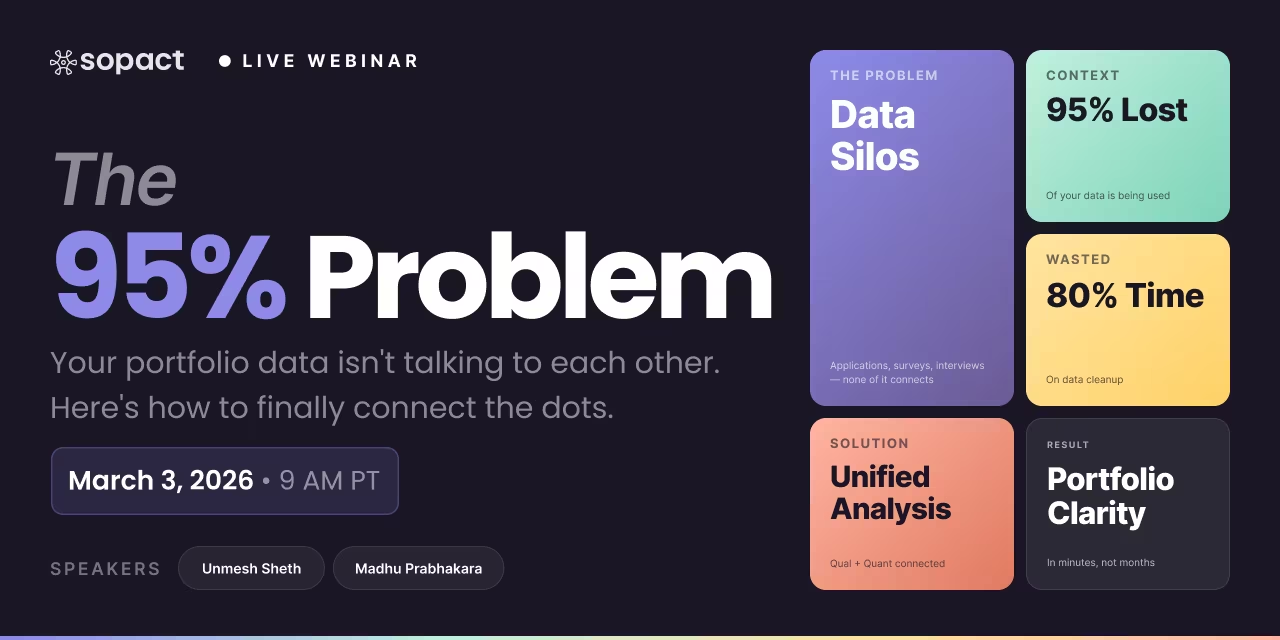
New webinar on 3rd March 2026 | 9:00 am PT
In this webinar, discover how Sopact Sense revolutionizes data collection and analysis.
Live application review example with citation evidence: 6-pillar pitch competition scoring. Applicant scoring AI for 3,000 submissions in under 3 hours.
By Unmesh Sheth, Founder & CEO, Sopact
Six weeks after selection, a board member asks a single question: "Why did applicant 247 score 3.2 on innovation?" Your program director opens the spreadsheet, finds the row, and sees a number. The number is there. The reasoning is not. The reviewer who assigned it moved on. The essays that informed it were never linked to the score. The decision is defensible only in the sense that it was made — not in the sense that it can be explained, reproduced, or learned from.
This is the Evidence Vacuum — the structural gap between the rubric a program defines and the evidence it actually captures in its scoring record. Programs invest weeks designing evaluation criteria and months collecting applications, then produce a scored spreadsheet with no citation trail connecting the two. When a funder, a board member, or a rejected applicant asks why a score is what it is, the honest answer is: because a reviewer felt that way, at that moment, on that day.
Before any rubric is built or any application collected, the most important decision is what the review cycle is supposed to leave behind. A shortlist is not enough. A scored spreadsheet is not enough. The output that makes your program defensible, improvable, and fundable is a scoring record — citation evidence connecting every score to the specific submission content that generated it.
The Evidence Vacuum is not a technology gap. It is an architectural one, and it persists in every program that separates the act of reading from the act of scoring.
In manual application assessment, reviewers read submissions and enter scores. The reading and the scoring are two separate acts performed by the same person under time pressure. The connection between them — the specific sentence that made a proposal "strong" on innovation, the specific line in a recommendation letter that made a candidate "exceptional" on leadership — exists only in the reviewer's memory. It is not captured. It cannot be reproduced. It is gone the moment the reviewer moves to the next application.
This is why manual application review fails at scale in a way that has nothing to do with the reviewers' quality. A program receiving 500 applications with a six-pillar rubric is asking twelve reviewers to read, evaluate, and score 500 submissions — and then reconstruct the reasoning for any decision, at any time, to any stakeholder. The reconstruction is impossible. The Evidence Vacuum makes it structurally impossible.
The vacuum deepens in three directions simultaneously. At the single-application level, no score is explainable without re-reading the submission. At the pool level, no score is comparable across reviewers without knowing how each reviewer interpreted each criterion. At the program level, no selection criterion can be validated against outcomes without knowing which criterion actually predicted success. The gap between rubric and record corrupts all three levels at once.
For scholarship management, this means essay quality is assessed and forgotten rather than documented and compared. For fellowship management, it means reference letter intelligence exists in reviewer impressions rather than in any queryable record. For grant programs, it means methodology rigor scores cannot be traced to the proposal language that warranted them.
AI application review closes the Evidence Vacuum by design. The citation is not something a reviewer generates after scoring — it is generated at the moment of scoring, by the system doing the scoring, against the specific content that drove the result.
Sopact Sense is an origin system — applications are collected inside it, not imported from another platform. Every document submitted through Sopact Sense is read at the moment of intake, before any reviewer opens their queue.
The scoring sequence is: application arrives → Sopact Sense reads every submitted document against your rubric criteria → a citation is generated per rubric dimension linking the score to the specific passage that produced it → reviewer receives a pre-scored ranked profile with evidence attached, not a blank form and a PDF stack.
This is what distinguishes AI application review from AI-enabled platforms that add a summarization button to a legacy collection tool. An AI-enabled platform helps a reviewer process one application faster. Sopact Sense processes the entire pool before any reviewer engages — 3,000 applications scored in under three hours, every submission evaluated, every criterion applied with identical interpretation across every applicant.
Rubric design drives everything. The quality of citation evidence is a direct function of rubric specificity. An anchored criterion — "Deployability: score 5 if applicant demonstrates physical deployment in at least 10 uncontrolled real-world environments with documented operational evidence; score 3 if deployment is controlled or lab-based; score 1 if deployment is prototype-only" — produces citation evidence that quotes the specific deployment claim in the submission and explains why it meets or does not meet the anchor. An unanchored criterion — "Innovation: rate from 1–5" — produces a number. The Evidence Vacuum survives unanchored rubrics even in AI-native systems.
Persistent unique ID from first submission. Every applicant receives a unique ID at the moment of first contact. That ID carries forward through every round of review, every interview score, every selection decision, and every post-program outcome. The application scoring record is the first entry in a longitudinal file — not a one-time event that ends when the committee announces results. This is how nonprofit impact measurement becomes connected to selection quality rather than separated from it by an administrative handoff.
Mid-cycle rubric iteration. Discovering that a criterion is ambiguous after 100 applications have been scored is standard. In manual review, that discovery requires re-reading and re-scoring all 100. In Sopact Sense, update the criterion definition and all submitted applications re-score automatically overnight. This transforms rubric design from a locked one-shot decision made before the cycle opens to a continuous calibration process.
The most useful application review example is not a template. It is a scored output — a real shortlist with citation evidence showing exactly what "applications assessment" looks like when the Evidence Vacuum is closed.
The example below is drawn from the Forge Pitch: AI Horizons competition. Three startup applications — ForgeSight Robotics, VeloSense AI, and TwinPlay Analytics — were scored by Sopact Sense against a six-pillar rubric: Deployability, HW-SW Integration, Pilot Traction, Technical Defensibility, Business Viability, and Ecosystem Commitment.
Each score is accompanied by the specific passage from the submission that generated it. This is what an application review example looks like when it closes the Evidence Vacuum: not a number, but a number with a reason.
This application review sample illustrates three patterns that appear across every program type. First, the strongest candidate (ForgeSight Robotics, 4.42) earns its score on criteria it dominates — but shows a genuine weakness on Ecosystem Commitment (3.5) that the citation makes explicit rather than averaged away. Second, the middle candidate (VeloSense AI, 3.75) scores well on technical criteria but fails on a single commercial criterion (Pilot Traction, 3.5 — no paying customers) that determines its "Hold" status. Third, the below-threshold candidate (TwinPlay Analytics, 3.33) scores highest on two criteria (Pilot Traction, Business Viability, both 4.0) but fails on the core rubric criterion (HW-SW Integration, 2.5 — no proprietary hardware). The rubric reveals a strong business that is a wrong fit — not a weak application.
This is what application scoring software is supposed to produce: not a ranked list, but an evidence record that makes every decision explainable, every pattern learnable, and every criterion validatable against outcomes.
Post-rubric AI evaluation is where most programs waste the scoring record they have built. The ranked shortlist goes to the committee. The committee selects finalists. The spreadsheet is filed. Three months later, a funder asks which selection criteria predicted cohort success — and the answer requires manual reconciliation of a decision record that was never designed to be queried.
The application review system in Sopact Sense is designed to be queried. Because every score traces to a citation, and every applicant has a persistent ID connecting their application record to every subsequent touchpoint, the post-award questions that funders ask become answerable from the system rather than from a staff member's memory.
For grant reporting: Which proposals scored highest on outcome measurement quality? Which grantees, three cycles later, delivered on the impact they described in their applications? The scoring record and the outcome record live in the same persistent ID chain — the query is direct, not reconstructed.
For pitch competition retrospectives: Which rubric criterion, across three competition years, best predicted which startups reached Series A? The answer requires correlating application scores to post-award milestones — possible only if both are connected to the same applicant record.
For accelerator programs: Which cohort application characteristics predicted the companies that completed the program versus those that dropped? That question, asked after cycle three, makes cycle four rubric design evidence-based rather than intuition-based.
The post-review workflow in Sopact Sense involves three concrete steps. Issue post-award instruments through the same platform — milestone surveys, outcome assessments, alumni follow-ups — so every response connects to the original application record automatically. Run the bias audit from the scoring record before announcing results, not after; reviewer scoring distributions across demographic dimensions surface before the announcement, not in a post-selection debrief. Archive the citation record as the rubric calibration baseline for the next cycle — which criteria produced the clearest citation evidence, which showed reviewer drift, which correlated with post-award outcomes.
Build anchored rubric criteria before opening applications. The single highest-leverage action in AI application review is rubric design. Unanchored criteria — "rate innovation from 1–5" — produce scores that are numbers. Anchored criteria — with explicit behavioral descriptors at each score level — produce scores that are citations. The Evidence Vacuum persists inside unanchored rubrics regardless of whether AI or humans do the scoring.
Do not treat the shortlist as the deliverable. The ranked shortlist is the input to committee deliberation, not its output. The deliverable is the selection decision with a scoring rationale attached — the specific criterion scores and the citations that support them. Programs that treat the shortlist as the final product of application review have not closed the Evidence Vacuum; they have moved it one step downstream.
AI scores unstructured content — that is where the differentiation lives. A 600-word executive summary contains more evaluation signal than every structured field in the application form combined. Programs that configure their rubric only against structured fields are leaving the highest-signal content unanalyzed. Configure rubric criteria to apply to essay content, narrative responses, and uploaded documents — Sopact Sense reads every word of every document against every applicable dimension.
Reviewing competition AI questions — whether AI can fairly evaluate qualitative content — are addressable through citation transparency, not dismissible. The citation is the accountability mechanism. When a reviewer or applicant challenges an AI score, the citation shows the specific passage that generated it. Challenge the citation against the rubric anchor. If the anchor is clear and the citation is accurate, the score is defensible. If the citation does not match the anchor, the rubric needs refinement — which is what rubric iteration mid-cycle is for.
The committee's time belongs on the edge cases. AI application review eliminates the screening phase. Human judgment belongs entirely on the 10–15% of applications where the scoring record reveals genuine ambiguity — strong on one dimension, weak on another; high AI score, low reviewer confidence; or demographic distribution patterns that require deliberate discussion before the announcement. The committee's job is to apply judgment where judgment is irreplaceable, not to repeat the scoring work the AI has already done.
AI application review is the process of using artificial intelligence to read, score, and rank submitted applications against predefined rubric criteria — for pitch competitions, grant programs, scholarship cycles, fellowship programs, and accelerator selection. Sopact Sense applies the same evaluation criteria to every submission, including unstructured narrative content like essays and uploaded documents, and produces citation-level evidence for each score — the specific passage from the submission that generated it.
An application review example is a scored output showing what AI-native application assessment actually produces: a ranked applicant profile with criterion-level scores and the specific submission evidence that generated each one. The ForgeSight Pitch: AI Horizons example on this page shows three startup applications scored against a six-pillar rubric — Deployability, HW-SW Integration, Pilot Traction, Technical Defensibility, Business Viability, and Ecosystem Commitment — with citation evidence per dimension per applicant.
Application assessment and application review are used interchangeably. "Application assessment" is more common in UK and Commonwealth English; "application review" is the US standard. Both describe the same process: evaluating submitted applications against program criteria to identify the strongest candidates. AI-native application assessment in Sopact Sense applies consistent rubric scoring to every submission — structured fields and unstructured narrative content — and produces a citation-backed scoring record regardless of which term your program uses.
The Evidence Vacuum is the structural gap between the rubric a program defines and the evidence it actually captures in its scoring record. Programs design six evaluation criteria. Reviewers apply impressions. Nothing connects the two. When a funder, board member, or rejected applicant asks why a specific score was assigned, the answer is that a reviewer felt that way — because no citation links the score to the submission content that generated it. AI-native review closes the Evidence Vacuum by producing citation evidence at the moment of scoring.
Applicant scoring AI is an artificial intelligence system that reads submitted application content — essays, proposals, form fields, uploaded documents — against defined rubric criteria and generates a score with citation evidence per criterion. Unlike keyword-matching tools, applicant scoring AI in Sopact Sense processes unstructured narrative content contextually and identifies the specific sentences in each submission that satisfy or fail to satisfy each rubric dimension.
Sopact Sense scores 3,000 applications in under three hours. Every submitted document is read in parallel by Sopact Sense's Intelligent Cell — no sequential processing, no reviewer fatigue, no rubric interpretation drift across panelists. Manual review of the same pool at fifteen minutes per application with twelve reviewers requires 750+ hours over eight to ten weeks. The time difference allows programs to run faster selection cycles and give human reviewers time to focus on finalists rather than screening.
Sopact Sense reads every word of every document: form fields, short-answer responses, executive summaries, uploaded pitch decks, research proposals, and reference letters. This is the critical distinction from keyword-matching tools. AI reads unstructured narrative content contextually and generates citation-level evidence showing which specific sentences drove each rubric score — closing the Evidence Vacuum on narrative content, not just structured fields.
Rubric changes in Sopact Sense trigger automatic re-scoring of all submitted applications. Adjust criteria weights, add a sub-criterion, rewrite an anchor — every application updates overnight. Manual review makes post-launch rubric changes practically impossible; AI scoring makes iterative refinement a standard part of the cycle. This matters most when the first 50 applications reveal that a criterion is ambiguous or when a funder adds a priority dimension after the cycle has opened.
Every applicant in Sopact Sense receives a persistent unique ID from first submission. This ID carries forward through interview scores, selection decisions, program participation, and post-program outcomes. Program administrators can query any cohort's application scoring record against their outcome data — enabling the longitudinal validation that establishes whether selection criteria actually predict program success. That intelligence makes each subsequent cycle more evidence-based than the previous one.
Post-rubric AI evaluation refers to the analysis performed after an initial scoring pass — typically to validate rubric performance, detect reviewer bias, or re-score applications when criteria are updated. In Sopact Sense, post-rubric evaluation includes reviewer scoring distribution analysis (detecting drift against the AI baseline), rubric dimension correlation against post-award outcomes, and automated re-scoring when any criterion is updated mid-cycle.
Sopact Sense surfaces reviewer scoring distributions against the AI scoring baseline throughout the review cycle — not just in the final tally. When a reviewer's scores on a specific rubric dimension diverge from the AI baseline by more than one standard deviation, or when scoring distributions show demographic correlations that appear before decisions are final, those signals surface as flags. The citation evidence per score also provides an audit mechanism: any score challenged as biased can be evaluated against the specific submission content and the rubric anchor that generated it.
Application review is the scoring and selection phase — reading submissions, applying rubric criteria, ranking candidates, and generating a defensible decision record. Application management software covers the full program lifecycle including intake, reviewer routing, selection, and post-award outcome tracking. Sopact Sense handles both. The review methodology described on this page is the scoring layer that sits at Step 2 of the four-stage Program Intelligence Lifecycle described on the application management software page.