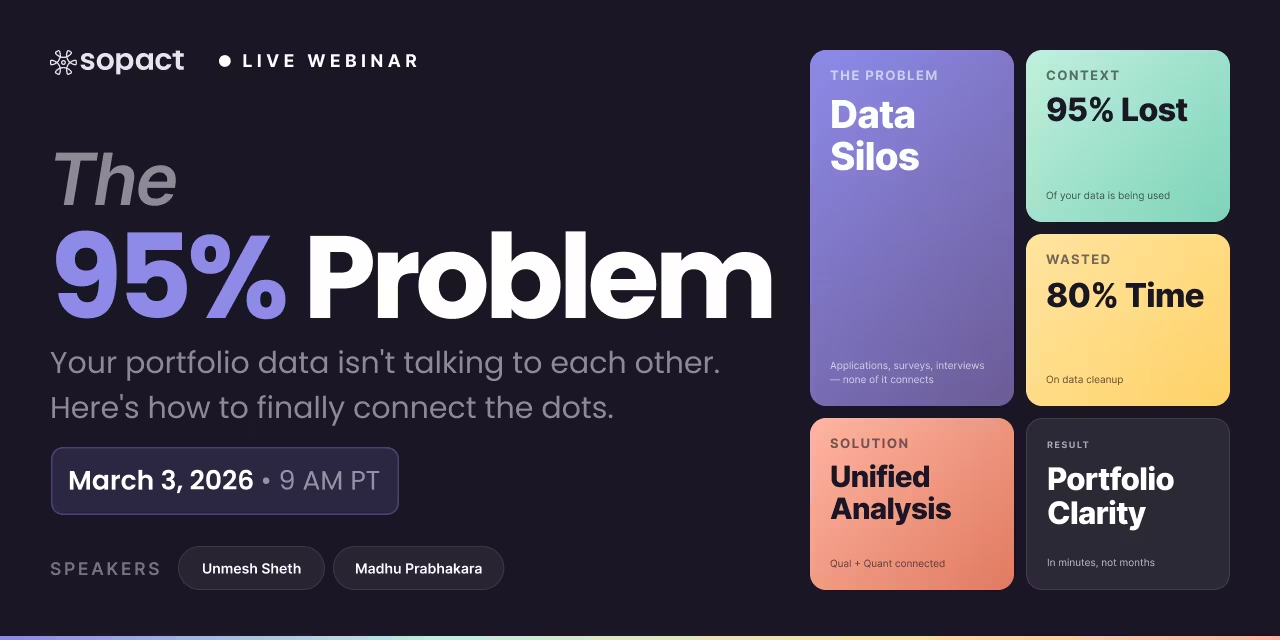
New webinar on 3rd March 2026 | 9:00 am PT
In this webinar, discover how Sopact Sense revolutionizes data collection and analysis.
Learn how to collect baseline data with unique IDs, validation rules, and AI analysis that eliminates 80% of cleanup time—so you prove real progress, not guesswork.
Most teams collect baseline data they cannot trust when decisions matter most. Surveys scatter across tools. Participant records duplicate. Qualitative context gets lost in separate files. By the time anyone compares baseline to outcome, weeks of cleanup have consumed the window for learning.
Baseline data is the verified starting condition of your participants — their skills, confidence, readiness, or performance — captured before any intervention begins. Without this anchor, "improvement" becomes guesswork. With it, every subsequent measurement wave has a credible reference point that boards, funders, and program teams can trust.
The core problem is structural, not personal. Traditional survey tools treat each data collection wave as independent. Google Forms does not remember that Maria completed a baseline survey six months ago. SurveyMonkey cannot link her pre-program confidence score to her post-program test results. Excel reconciliation introduces errors faster than it resolves them. Organizations spend 80% of their measurement time on data plumbing — exports, deduplication, manual matching — and only 20% on the analysis that actually informs decisions.
Clean baseline data collection reverses this ratio. When the system assigns unique participant IDs at enrollment, validates entries in real time, and automatically links every subsequent survey to the same record, teams shift from data janitors to insight generators. That is the architectural shift this article explains — and the workflow that Sopact Sense makes operational.
What you will learn in this article:
Let's start by understanding why most baseline collection systems fail before the first report ever gets written.
The failure pattern repeats across sectors — workforce programs, education initiatives, health interventions, community development. Organizations design thoughtful measurement frameworks, then discover their data infrastructure cannot support the comparison those frameworks require.
Survey platforms, spreadsheets, and CRMs each hold pieces of participant data. Teams export from Google Forms, match names manually in Excel, then upload to Salesforce or a funder reporting portal. One inconsistency — "Jon" versus "John," a changed email address, a misspelled last name — creates duplicate records that cascade through every analysis.
The compounding effect is severe. At baseline, one typo creates one duplicate. At midline, that duplicate generates two mismatched records. At endline, the system contains three conflicting participant profiles — and analysts spend days untangling which entries belong to the same person. Organizations report spending 80% of their total measurement time on this kind of data reconciliation rather than analyzing what actually changed.
For programs that need to demonstrate credible evidence to funders, this fragmentation undermines the entire measurement strategy. Dashboards built on duplicated data show inflated participation counts, distorted averages, and unreliable trend lines.
Without participant-level identifiers that persist across every survey wave, pre-program and post-program data cannot connect reliably. Program managers ask "Did Maria's confidence improve?" but the system only shows aggregate averages across the whole cohort. The individual trajectory — the story of one participant's growth — remains invisible.
This matters because aggregate averages hide critical variation. A cohort average confidence increase from 5.0 to 6.5 sounds encouraging. But if half the participants improved from 3 to 9 while the other half dropped from 7 to 4, the program has a segmentation problem that aggregate data completely obscures. Individual-level baseline tracking reveals these patterns. Aggregate-only systems bury them.
For organizations running longitudinal studies with three, four, or five measurement waves, the absence of unique IDs makes multi-wave comparison essentially impossible without heroic manual effort. The architectural principles behind clean longitudinal tracking — persistent identifiers, mirrored survey fields, automatic wave connection — are covered in detail in Longitudinal Data Collection.
Baseline surveys often include open-ended questions: "What barriers do you face?" or "What are your goals for this program?" These qualitative responses contain the richest context for understanding where participants start. But traditional analysis requires manual reading, coding framework development, and weeks of consistent tagging across hundreds of responses.
By the time qualitative baseline themes surface, the program has moved past its early weeks — exactly when baseline insights would have been most useful for tailoring support, adjusting curriculum, or identifying at-risk participants.
Organizations that use Sopact Sense's Intelligent Cell to analyze open-ended baseline responses extract structured themes in minutes, not weeks. The result: program teams know what participants need while there is still time to respond. For a detailed walkthrough of how AI-powered qualitative analysis replaces manual coding, see How to Analyze Qualitative Data from Interviews.
Baseline collection succeeds when the system prevents errors at the point of entry rather than attempting to fix them downstream. Sopact Sense structures baseline workflows around three architectural principles: persistent participant identity, validation at entry, and automatic wave linking.
These principles solve the structural problems described above — not through better spreadsheet skills or more careful data entry, but through system design that makes clean data the default outcome.
Traditional survey tools treat each submission as independent — a standalone row in a spreadsheet with no memory of previous interactions. Sopact Sense reverses this model. The Contacts feature functions as a lightweight CRM where each participant registers once and receives a permanent unique ID.
Every subsequent interaction — baseline survey, mid-program check-in, post-program assessment, six-month follow-up — links automatically to that same Contact record. The participant's demographic information, enrollment date, cohort assignment, and site location travel with them through every measurement wave.
Girls Code Example: A technology training program for young women (ages 15-17) enrolls 65 participants through a Contact Form. Each student receives a unique ID and a personal survey link. When Student #23 completes her baseline confidence survey, the system already knows her cohort, site, and enrollment date. Six months later, when she completes the post-program assessment through the same personal link, the system instantly connects her baseline score (4/10 confidence) to her outcome score (8/10 confidence) — a clear 4-point improvement with zero manual matching.
This architecture eliminates the duplicate-entry problem that consumes days of cleanup time. One person, one ID, forever. For a complete walkthrough of the Girls Code data collection workflow from enrollment through report generation, see Survey Report Examples.
Clean baseline data starts with preventing bad entries, not discovering them weeks later during analysis. Sopact Sense supports field-level validation rules that run in real time as participants complete surveys:
Type-level validation ensures numeric fields reject text entries, email fields verify format, and date fields accept only valid dates. These basic guardrails prevent the majority of data quality issues that traditional tools allow through unchecked.
Range validation catches impossible values immediately. A confidence score of "150" on a 1-10 scale, a birthdate in the future, or a negative count value — all get flagged at the moment of entry, not months later during report preparation.
Required field enforcement means critical baseline measures cannot be skipped. Participants cannot submit until core variables are answered, which prevents the missing-data gaps that undermine statistical power in pre and post survey analysis.
Skip logic hides irrelevant questions based on previous answers, keeping the survey experience focused while ensuring all applicable fields get completed. For comprehensive principles on designing effective survey instruments, see Survey Design Best Practices.
These validation rules running in real time mean no invalid data enters the system. No cleanup cycles delay your analysis. The data is clean at the source.
The architectural breakthrough: relationship assignment. When you create a mid-program or post-program survey in Sopact Sense, you explicitly link it to your Contact object. From that moment, every submission automatically carries the participant's unique ID and baseline information forward.
The workflow looks like this: Enrollment creates a unique Contact ID. The baseline survey links to that Contact. The mid-program survey inherits the same ID. The post-program comparison happens instantly. No exports. No manual joins. No reconciliation spreadsheets. Your baseline and all follow-up waves live in one continuous dataset from day one.
This is the architecture that enables credible pre and post surveys. When baseline and outcome surveys share the same underlying Contact link, matched-pair analysis becomes automatic rather than requiring weeks of manual record matching.
For organizations running multi-wave programs beyond simple pre-post, this architecture scales to three, four, or five measurement waves with the same automatic linking. See Longitudinal Study Design for implementation details on maintaining 75-85% retention rates across extended measurement timelines.
The statistic is well-documented: data teams across industries spend roughly 80% of their time cleaning and preparing data, leaving only 20% for actual analysis. Baseline collection amplifies this problem exponentially because one uncaught error at the starting point multiplies across every subsequent measurement wave.
Consider what happens when baseline inconsistencies go unchecked in a workforce training program:
Survey A uses a 1-5 confidence scale while Survey B at a different site uses 1-10. Some participants type "very confident" in numeric fields. Others leave baseline blank but complete the post-program survey. Date formats mix between MM/DD/YYYY and DD/MM/YYYY across sites.
Each of these inconsistencies requires manual resolution before any comparison is possible. Multiply by hundreds of participants across multiple sites and several measurement waves, and the cleanup burden consumes weeks — sometimes months — of analyst time.
The deeper cost is missed learning opportunities. By the time baseline data is clean enough to analyze, the program has advanced past the point where early insights could have informed adjustments. Baseline becomes a compliance checkpoint rather than a tool for adaptive management.
Sopact Sense enforces data quality at the entry point through validation rules that prevent — rather than detect — the most common baseline data errors:
Type-level validation rejects text in numeric fields, verifies email formats, and enforces date structures. Range validation catches values outside defined boundaries — confidence scores must fall between 1 and 10, attendance percentages between 0 and 100. Consistency validation ensures all sites use identical field definitions and scales, eliminating the cross-site standardization problem. Completeness validation marks critical baseline fields as required, preventing the missing-data gaps that reduce statistical power in longitudinal comparisons.
Scholarship Program Example: A foundation managing 500 scholarship applications implemented validation rules for baseline academic scores and financial need indicators. Previously, analysts spent six weeks cleaning submissions — wrong formats, missing fields, duplicate entries from applicants who submitted multiple times. After implementing validation: two days of final review. The team redirected those four saved weeks to building selection rubrics and bias checks, improving award quality significantly.
Validation prevents bad entries, but participants sometimes need to correct legitimate errors in their baseline submissions — a wrong phone number, a misremembered prior job title, an accidentally selected wrong option.
Sopact Sense handles this through persistent unique links. Each participant's baseline submission has a personal URL. When they need to correct information, they return to that same link — no new submission, no duplicate record. The system tracks the change with a timestamp, maintaining full audit history while keeping the dataset clean.
This matters for governance. When boards or funders ask "How do we know this baseline data is accurate?" you can demonstrate: participant-verified, timestamped, traceable back to source, with a complete change history.
Organizations frequently confuse these terms, leading to measurement designs that answer the wrong question. Both matter. They serve different strategic purposes. Understanding when to use each — and when to combine them — separates credible evidence from impressive-looking reports that cannot withstand scrutiny.
Baseline captures your specific participants before your intervention begins. It is internal, longitudinal, and focused on change within your cohort over time. Baseline answers: "Did our program move people from their starting point?"
A youth employment program measures job-readiness confidence at intake (baseline score: 4.2 out of 10) and again six months later (outcome score: 7.8). The 3.6-point gain demonstrates change attributable to the program period — same participants, measured before and after, with the unique ID linking both data points.
Benchmark compares your results against external standards or industry averages. It is comparative, contextual, and focused on relative performance. Benchmark answers: "Are our outcomes competitive with peer organizations or sector norms?"
The same youth employment program compares their 78% job placement rate against the national youth employment average (52%) and peer programs in similar cities (65%). This benchmark context demonstrates that outcomes exceed comparable standards — evidence that strengthens funding proposals and positions the program competitively.
The most powerful measurement strategies use baseline and benchmark together. Baseline proves you caused change — participants moved from Point A to Point B during your program period. Benchmark proves your change matters — the magnitude of movement exceeds what comparable programs typically achieve.
This dual approach satisfies both internal learning needs ("Are we improving our participants?") and external accountability needs ("Are we competitive with best practices?"). For defining the right KPIs to track from baseline forward, see Survey Metrics and KPIs.
Using benchmark instead of baseline: Comparing post-program results to national averages does not prove your program worked. Participants may have started above average. Without baseline, you are guessing at causation.
Claiming baseline alone shows excellence: Baseline shows change, not absolute quality. A 2-point confidence gain (5→7) represents real progress, but if the benchmark standard is 8.5, your participants still fall below sector expectations. Both perspectives inform different stakeholders.
Mixing metric definitions across baseline and benchmark: If you track "job placement within 90 days" internally but compare against benchmarks using "placement within 180 days," the comparison produces misleading conclusions. Metric alignment is non-negotiable.
Sopact Sense stores both participant-level baseline data and external benchmark references in the same system. Intelligent Column can analyze "How does our pre-post improvement compare to industry standards?" automatically — combining longitudinal baseline tracking with comparative benchmark analysis in one query.
Clean baseline collection is necessary but not sufficient. The transformation happens when AI analyzes both quantitative scores and qualitative narratives simultaneously — turning static baseline records into dynamic learning tools while programs are still running.
Traditional qualitative analysis of baseline data requires reading hundreds of open-ended responses, developing coding frameworks, manually tagging themes, calculating frequencies, and checking inter-coder reliability. The process typically takes four to eight weeks for a single program cohort.
Intelligent Cell automates this process. Point it at any open-ended baseline question — "What are your biggest barriers to employment?" or "Describe your current confidence level with technology" — and it extracts structured themes in minutes.
Community Health Example: A program collects baseline narratives from 300 participants: "Describe your current access to healthcare." Intelligent Cell processes all responses and identifies dominant themes: transportation barriers (45%), cost concerns (38%), language challenges (22%), trust issues with providers (18%), and scheduling conflicts (12%). Program designers see immediately that transportation is the primary baseline barrier — before the intervention even begins — and can adjust program delivery to address it.
The value is speed and consistency. Intelligent Cell applies the same analytical lens to every baseline response, eliminating coder bias and compressing processing time from weeks to minutes. For a complete demonstration of how this works across interview transcripts, open-ended survey responses, and uploaded documents, see Survey Analysis.
Baseline collection captures multiple dimensions — demographics, readiness scores, confidence levels, prior experience, stated goals and barriers. But which baseline factors actually predict program success? Traditional analysis requires statistical expertise and weeks of testing.
Intelligent Column tests correlations across baseline variables in plain English. Ask: "Do participants with higher baseline confidence scores show greater skill improvement at outcome?" The system analyzes quantitative patterns and qualitative context together, then delivers a clear answer with supporting evidence.
Girls Code Insight: The program wanted to understand baseline predictors of success. Intelligent Column analyzed the relationship between baseline coding experience and post-program test scores: weak correlation (r=0.23). However, when analyzing baseline confidence paired with peer support mentions in open-ended responses, a strong correlation emerged (r=0.71). The finding — prior experience matters less than confidence plus social support — reshaped how the program assigned mentors and structured peer learning groups.
This is precisely the kind of insight that baseline data should produce: actionable, timely, and directly applicable to program design decisions. For the full correlation methodology and Girls Code analysis walkthrough, see Pre and Post Survey Analysis.
Baseline data becomes credible evidence only when communicated clearly to stakeholders. Traditional reporting requires exporting data, building pivot tables, writing narrative summaries, designing visual layouts, and iterating through review cycles over weeks.
Intelligent Grid generates designer-quality baseline reports from plain-English instructions. Tell it: "Create an executive summary showing baseline participant demographics, confidence score distribution, top five barriers identified in open-ended responses, and completion rates by site." Minutes later, you have a complete report with verified numbers, participant quotes, and visualizations — published as a live link that updates automatically as new baseline data enters the system.
Girls Code Report Generation: The program generated a complete impact report showing +7.8 average test score improvement, 67% of participants building web applications by mid-program, and confidence levels shifting from mostly "low" at baseline to 33% "high" at post-program. The report included both quantitative metrics and direct participant quotes explaining what drove the change. Total generation time: under five minutes. For the step-by-step walkthrough of this exact report generation process, see Survey Report Examples.
Traditional approaches treat baseline as a one-time snapshot — collect it, file it, retrieve it months later for comparison. The Intelligent Suite enables continuous baseline learning where insights flow in real time:
Baseline themes surface immediately through Intelligent Cell, informing early program adjustments while participants are still enrolled. Correlations revealed by Intelligent Column identify which baseline factors predict success, guiding how staff allocate mentoring and support resources. Reports generated by Intelligent Grid update automatically as new baseline cohorts enroll, keeping stakeholders continuously informed. The entire learning cycle — from baseline collection to actionable insight — compresses from months to minutes.
This is the shift from baseline as compliance checkbox to baseline as active decision-support tool. Organizations that implement this model report that baseline reporting cycles previously requiring six to eight weeks now complete in under an hour.
The ultimate test of baseline data quality: can you confidently compare it to post-program results without weeks of manual reconciliation? Traditional workflows fail this test regularly. Sopact Sense passes it automatically through the architectural choices described above.
Most organizations collect baseline in one system, midline in another, and endline in spreadsheets downloaded from yet another tool. When comparison time arrives, analysts face a familiar nightmare:
"Maria Garcia" at baseline becomes "M. Garcia" at midline and "Maria G." at endline. Email addresses change between waves. Some participants skipped midline but completed endline. Demographic information conflicts across submissions. Analysts spend weeks in Excel attempting fuzzy matches on names and dates, making judgment calls that introduce uncertainty into every comparison.
The fundamental problem: these tools were not designed for longitudinal tracking. Each survey is a standalone snapshot. Connecting snapshots across time requires infrastructure that generic survey tools do not provide.
Sopact Sense resolves this through persistent unique identifiers assigned at enrollment. Each participant carries one ID through every survey wave. No matching required — the system knows Maria at baseline is the same Maria at midline and endline because she carries the same Contact ID throughout.
Girls Code Implementation: 65 participants enrolled via Contact Forms at program start. Each student received a unique ID and personal survey link. Mid-program and post-program surveys linked to the same Contact object automatically. When comparing confidence scores across waves, the system instantly showed each participant's individual trajectory: Student #23 scored 4/10 at baseline, 6/10 at midline, 8/10 at post-program. Student #41 scored 7/10 at baseline, 5/10 at midline, 8/10 at post-program — revealing a dip-and-recovery pattern that aggregate averages would have completely hidden.
Real-world programs face attrition. Not every participant completes every survey wave. Traditional analysis either excludes incomplete cases (losing valuable data) or imputes missing values (introducing assumptions).
Sopact Sense handles missing waves with full transparency: the data grid shows exactly which participants completed which waves. Analysis tools filter to matched pairs when needed (baseline plus endline minimum). Intelligent Column can compare "participants who completed all waves" versus "participants with missing midline" as separate cohorts, testing whether attrition introduces bias. Reports note completion rates explicitly, maintaining methodological transparency.
No hidden assumptions. No data manipulation. Clear accounting of who participated when — the kind of transparency that builds funder confidence.
Numbers show the magnitude of change. Narratives explain why change happened. Traditional systems force a choice — analyze scores or read stories. Sopact Sense combines both simultaneously.
When comparing baseline to outcome, Intelligent Column answers questions like: "Which participants improved most in confidence, and what reasons did they give?" The result combines quantitative ranking (identifying the top 20% of improvers) with thematic analysis of their baseline and endline open-ended responses — revealing that hands-on projects and peer support were the primary confidence drivers. For organizations designing surveys that capture both quantitative and qualitative dimensions effectively, see Qualitative and Quantitative Surveys.
Funders and boards ask tough questions about baseline comparisons. "How do we know the baseline data is accurate?" "What percentage completed both baseline and endline?" "Can you show individual improvement stories, not just averages?" "How did you handle participants who left the program?"
Sopact Sense provides verifiable answers to each question. Every baseline submission carries a timestamp, unique link, and participant verification. Completion rates calculate automatically. Individual progress trajectories pull verified quotes from the same participant at baseline and endline. Attrition gets tracked and reported transparently.
Foundation Audit Example: A foundation funding 12 workforce training programs required verified baseline-to-outcome data. Programs using Sopact Sense demonstrated 89% baseline completion at enrollment and 76% endline completion at graduation, with full audit trails showing precisely when each participant submitted responses. Programs relying on traditional survey tools faced multiple "data quality questions" from the funder — unable to verify whether baseline and outcome submissions matched the same individuals.
The governance advantage extends beyond efficiency. Clean pre-post comparison with audit trails supports GDPR and CCPA compliance through traceable data handling, methodological transparency through documented collection procedures, and adaptive management through real-time baseline insights that inform course corrections while programs are running.
This is the shift from defensive measurement — scrambling to prove data integrity after the fact — to confident evidence that speaks for itself. For how these baseline comparisons feed into comprehensive stakeholder reporting, see Impact Reporting.
The Girls Code program illustrates how clean baseline architecture creates a measurement foundation that flows naturally through every subsequent stage — from enrollment through correlation analysis to board-ready reporting.
Stage 1 — Baseline enrollment: 65 young women (ages 15-17) enrolled through Sopact Sense Contact Forms. Each received a unique ID linking their demographic information, prior coding experience, and initial confidence self-assessment.
Stage 2 — Pre-program survey: Baseline surveys captured both quantitative measures (test scores, confidence ratings on a 1-10 scale) and qualitative context (open-ended responses about learning goals, perceived barriers, and expectations). Validation rules ensured all critical fields were complete and properly formatted.
Stage 3 — Mid-program pulse: A short mid-program survey checked motivation, confidence, and project progress. Because the survey linked to the same Contact ID, program staff could instantly compare each student's mid-program state to her baseline — identifying students whose confidence dropped despite improving test scores.
Stage 4 — Post-program assessment: The final survey mirrored baseline questions exactly, enabling clean pre-post comparison. Intelligent Column automatically correlated test score improvement (+7.8 average points) with confidence shifts and identified that 67% of participants had built web applications by mid-program.
Stage 5 — Impact reporting: Intelligent Grid generated a complete designer-quality report in under five minutes — including executive summary, quantitative metrics with charts, qualitative themes with participant quotes, and recommendations for the next cohort. The report published as a live link that the program could share directly with funders.
The critical finding: test scores and confidence did not correlate as expected. Some high-scoring students reported low confidence, while some lower-scoring students felt highly confident. This insight — impossible to surface without baseline-to-outcome individual tracking and mixed-methods analysis — led the program to restructure how it assigned peer mentors and supported students through portfolio development.
This is the kind of learning that clean baseline data makes possible. Not just "Did scores improve?" but "For whom did scores improve, why did confidence lag for some, and what should we change?"
Baseline data should be the foundation of organizational learning, not a once-per-year compliance ritual. When collection workflows keep data clean from the start, when validation prevents 80% of cleanup time, when unique IDs enable automatic pre-post comparison, and when AI analyzes qualitative and quantitative signals together in minutes — baseline transforms from static snapshot to continuous insight engine.
Traditional tools treat baseline as a filing cabinet exercise. Collect it, store it, pull it out months later, and hope the data still makes sense. Sopact Sense treats baseline as the first step in a continuous feedback loop: collect it cleanly, analyze it immediately, use insights to improve programs while they are still running, then measure again to close the loop.
That is the shift from measurement theater to genuine learning. From data you cannot trust to evidence boards believe. From months of reconciliation to minutes of insight. From baseline as administrative burden to baseline as strategic advantage.
Organizations that master clean baseline collection do not just report better — they improve faster, waste less time on data plumbing, and build the credibility that attracts sustained funding. That is what happens when your measurement foundation is genuinely reliable.
For how baseline data integrates into broader organizational evaluation frameworks, see Monitoring and Evaluation. For managing the ongoing stakeholder relationship that baseline collection initiates, see Stakeholder Feedback.
Baseline data captures the verified starting condition of participants before any intervention begins — their skills, confidence, readiness, or other key metrics. It matters because without this anchor point, you cannot credibly prove that your program caused improvement. Boards and funders require baseline evidence to distinguish real progress from activity reports. Clean baseline collection with unique participant IDs creates the foundation for every subsequent measurement wave, enabling matched pre-post comparison that withstands scrutiny.
Baseline measures your specific participants before your program starts, tracking individual change over time within your cohort. Benchmark compares your group's results against external standards or industry averages to assess relative performance. Baseline answers "Did we cause improvement?" while benchmark answers "How do our results compare to peers?" The strongest evidence strategies combine both — baseline proves change happened, benchmark proves the change is significant relative to comparable programs.
The three most damaging errors are: collecting baseline without unique participant IDs (making pre-post matching impossible), using inconsistent scales or definitions across sites or survey waves (requiring weeks of standardization before comparison), and separating qualitative open-ended responses from quantitative scores (losing the context that explains why numbers changed). Each mistake compounds across measurement waves, turning what should be straightforward comparison into months of data reconciliation.
Focus on four to seven core measures that directly connect to program goals — combining quantitative scores with one or two qualitative "why" questions. Fewer high-quality metrics beat dozens of surface-level indicators that fragment attention and complicate analysis. Every baseline measure should have a clear corresponding post-program question so matched comparison is straightforward. Sopact Sense's Intelligent Cell converts open-ended baseline responses into structured themes so you can quantify qualitative signals without manual coding.
Sopact Sense assigns each participant a unique ID and personal survey link at enrollment through its Contacts feature. Every subsequent survey — mid-program, post-program, or follow-up — connects automatically to the same record. Participants who need to correct baseline information return to their unique link rather than creating a new submission. The system maintains a timestamped audit trail of all changes, ensuring data integrity while eliminating the duplicate entries and reconciliation cycles that consume 80% of traditional analysis time.
Yes. Sopact Sense stores numeric scores and open-ended text responses side-by-side from initial collection. The Intelligent Suite analyzes both simultaneously: Intelligent Cell extracts themes from narrative responses, Intelligent Column tests correlations between quantitative scores and qualitative patterns, and Intelligent Grid generates comprehensive reports that weave numbers and participant voices together. This mixed-methods integration happens in minutes rather than requiring separate qualitative coding software like NVivo or ATLAS.ti.
Collect baseline data at enrollment or intake — before any intervention activities begin. Late baseline collection contaminates the starting-point measurement because participants may already have received some program benefit. Ideally, baseline survey completion is a required step in the enrollment process, captured through the same system that will host mid-program and post-program surveys. This timing ensures the cleanest possible anchor for subsequent comparison.
Sopact Sense makes participation gaps transparent in the data grid, showing exactly which individuals completed which waves. For analysis, you can filter to matched pairs (participants with both baseline and endline) or analyze complete-case and incomplete-case cohorts separately. Intelligent Column can test whether missing-baseline participants differ systematically from those who completed it, checking for attrition bias. Reports note completion rates explicitly, maintaining methodological transparency rather than hiding gaps.