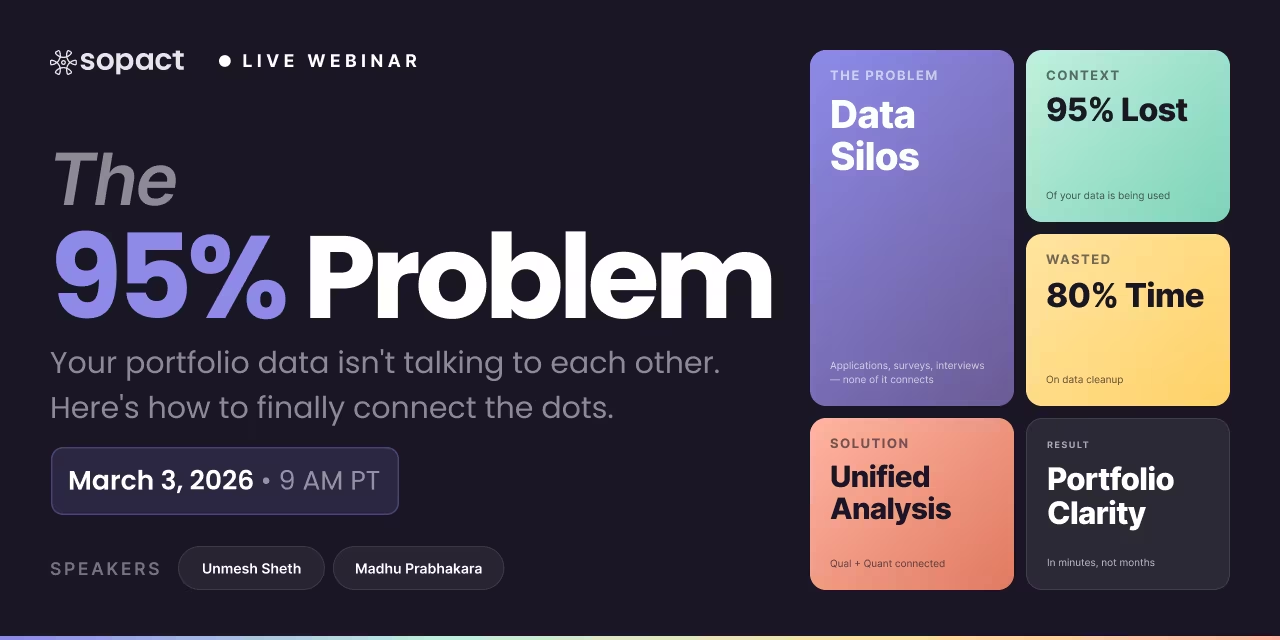
New webinar on 3rd March 2026 | 9:00 am PT
In this webinar, discover how Sopact Sense revolutionizes data collection and analysis.
Sopact Impact Intelligence aggregates ESG and impact data across supply chain partners, portfolio organizations, and subsidiaries — reading every document, tracking every commitment, generating board-ready reports the night the quarter closes
Right now, your team is opening 40 partner folders, re-reading documents nobody has fully processed, and assembling a sustainability report by hand. Sopact reads every document, holds every commitment, and generates board-ready ESG reports overnight.
This page covers ESG and impact data aggregation across portfolios — supply chain partners, subsidiary organizations, investee companies, or any structure where a corporate sustainability team needs to collect, analyze, and report on data from dozens of organizations who each submit in different formats, on different timelines, with different levels of completeness. It is not about individual grant program outcome reporting — that is covered separately. If you manage a portfolio of organizations and need the ESG intelligence connecting them — read on.
The problem every corporate sustainability director eventually hits is not a lack of data. It is a lack of intelligence connecting the data that already exists. Forty supply chain partners each submitted their quarterly sustainability update. Thirty of them used the template you sent. Eight used a modified version. Two sent PDFs with no structured data at all. One sent an email with numbers in the body text.
That is before the analysis begins. Before anyone has cross-referenced what Partner 17 committed to at onboarding against what they are now reporting in month nine. Before anyone has read the narrative section of Partner 23's Q2 submission — the one that mentions a regulatory issue on page four that, had it been caught in August, would have changed three downstream decisions. Before anyone has aggregated across the full portfolio to answer the board's question: are our supply chain sustainability commitments tracking toward the targets we published?
The assembly sprint that follows typically takes three to six weeks. By the time the report reaches the board, it describes a portfolio that has already moved on. Risk signals that appeared in documents six weeks ago have not been acted on because nobody got to page four. Commitments made at partner onboarding have drifted from what is being reported, but the drift is invisible until someone manually cross-references fifty documents side by side.
Sopact Impact Intelligence eliminates this problem at its root — not by adding another aggregation layer, but by reading every document the moment it arrives, carrying every commitment forward from onboarding, and generating portfolio-level intelligence continuously so the board report is ready the night the quarter closes.
Supply chain ESG data aggregation is the process of collecting sustainability and impact data from dozens or hundreds of partner organizations — suppliers, subsidiaries, funded organizations, portfolio companies — and synthesizing it into a coherent picture of portfolio-level performance. It is the work that sits between what individual partners report and what the board or external stakeholders need to see.
The structural challenge is that every partner in your supply chain or portfolio is a separate organization with its own systems, its own reporting habits, and its own interpretation of what a sustainability metric means. You can send a standardized template, and many partners will use it. Some will not. Some will add columns. Some will submit narrative documents instead. Even the partners who use your template exactly will interpret individual questions differently — and the difference only becomes visible when someone reads both carefully enough to notice.
Sopact Impact Intelligence handles this at the document level, not the template level. Rather than requiring every partner to submit perfectly formatted data, Sopact reads whatever arrives — PDFs, spreadsheets, narrative reports, emails — extracts the structured intelligence from each submission, and maps it to your ESG framework automatically. The program team receives comparable data across the portfolio regardless of how each partner chose to submit.
Commitments made at onboarding become the baseline for every subsequent report. When a supply chain partner completes their onboarding assessment and commits to specific sustainability targets — emissions reduction by year two, living wage certification by year three, water use efficiency improvement by 15% — those commitments become the standard against which every future submission is evaluated. Sopact carries that baseline forward automatically. When a partner's Year 2 submission arrives, Sopact cross-references it against their onboarding commitments without anyone pulling up the original document. Deviations surface immediately. Strong performance gets credited to the specific commitment it fulfills.
Late and incomplete submissions get resolved before they create portfolio gaps. A supply chain portfolio where three of fifty partners have not submitted creates a board report with three visible gaps — or a report where someone filled those gaps with estimates that nobody can later distinguish from actual data. Sopact identifies missing submissions and incomplete data automatically, flagging specific partners with specific missing items so the program team can follow up precisely rather than sending blanket reminders to the full portfolio. See how Impact Intelligence handles supply chain aggregation →
The most important information in a corporate sustainability portfolio is almost never in the structured data fields. It is in the narrative sections that most aggregation tools ignore entirely — the qualitative submissions, the explanatory paragraphs in financial reports, the footnotes in emissions data, the risk disclosures buried on page seven of a quarterly update.
ESG data intelligence is the capability that turns those documents into actionable signals rather than unread files. It is the difference between knowing that a supply chain partner reported a 12% carbon reduction and knowing that the same partner's narrative mentions a pending regulatory change that may reverse that progress — a signal that appears in text, not in a data field, and that requires reading the document to find.
Sopact Impact Intelligence reads every document across the portfolio the moment it arrives — in full, with the ability to cross-reference findings against what was said at onboarding, what was committed at the start of the relationship, and what was reported in previous cycles. When a risk signal appears in a partner's narrative, it is flagged the day the document is uploaded — not the day someone manually reaches page seven. When a partner's language about a key metric shifts between Q2 and Q3 in ways that suggest methodological change, that inconsistency surfaces before it propagates into the portfolio aggregate.
Portfolio-level patterns emerge from the full document record. A corporate sustainability director managing fifty supply chain partners cannot read 200 pages of narrative reports per quarter and identify the patterns that matter. Which partners are consistently outperforming their commitments and why? Which are showing early signals of backsliding that have not yet appeared in headline numbers? Which ESG dimensions are tracking well across the portfolio, and which show systemic underperformance suggesting a shared barrier rather than individual variation? These questions cannot be answered from structured data alone. They require reading at scale — which until recently was not operationally possible. Sopact does it continuously, across the full portfolio.
Your existing ESG framework stays in place. Sopact maps to your existing impact rubric — IRIS+, GRI indicators, custom ESG dimensions, SDG alignment, or any proprietary framework your team has developed — rather than forcing a new taxonomy. Supply chain partners who have been reporting against your existing framework for two years do not need to change anything. Sopact reads what they send and maps it to your framework automatically. See how Impact Intelligence handles ESG data intelligence →
The phrase "automated ESG reporting" is applied to tools that automate one narrow step — a template that pre-populates, a dashboard that refreshes when someone uploads a cleaned export, a formatting tool that makes data presentable after someone else has assembled it. That is not automation. It is one less step in a process that still requires three weeks of manual work everywhere else.
True portfolio ESG reporting automation means documents arrive, get read, get cross-referenced against prior submissions and onboarding commitments, generate risk flags where signals emerge, and update the board-ready portfolio report — without a human manually processing anything between document receipt and report availability. The program team's job shifts from assembling the report to acting on what the report reveals.
Sopact Impact Intelligence generates six report types per portfolio organization per quarter, automatically. An investee or partner scorecard with structured assessment across all ESG dimensions, evidence-linked scores, and trend indicators — generated at onboarding and updated every quarter. A gap and risk memo that surfaces data gaps, contradictions between documents, and emerging risk patterns flagged on every document upload, not once per quarter. An IC or board preparation brief that synthesizes everything needed before a review meeting. An LP or board portfolio narrative that is publication-ready language for external stakeholders, with source citations traceable to original documents. A longitudinal trend report showing multi-year trajectory across the full history Sopact holds for each partner. And a portfolio summary aggregating across all partners into the single-view presentation your board needs for quarterly review.
All six generated overnight when the quarter closes. The assembly sprint is eliminated — not abbreviated. See the full automated reporting architecture →
What makes Impact Intelligence structurally different from every other ESG aggregation tool is that context compounds across every stage of the partner relationship rather than resetting each quarter.
Traditional ESG portfolio tools treat each reporting cycle as a fresh start. Q1 data lives in Q1's folder. Onboarding commitments live in the onboarding spreadsheet. Risk signals from due diligence or initial partner assessment live in evaluation documents nobody reads after the relationship is established. By year two, the program team has essentially lost the thread of what each partner originally committed to and why.
Sopact carries the full record forward from the first document through the final report. The risk flag that appeared in a partner's initial assessment is still active context when their Q8 submission arrives. The commitment to living wage certification made at onboarding is the standard against which every subsequent labor practices report is evaluated — automatically, without anyone manually reconstructing that context. The early signal of methodological drift that appeared in the Q3 narrative is part of the analysis informing the Q4 board brief.
For supply chain sustainability directors, this means the intelligence available at year two of a partner relationship is genuinely cumulative — not a new snapshot assembled from scratch each cycle, but a connected record that gets more useful the longer the relationship runs. For ESG program managers assembling portfolio reports for boards or regulatory disclosure, it means every claim in the report is traceable to a specific document and passage — not an aggregate that no one can audit back to source.
The portfolio folder that used to require three weeks of preparation before a quarterly review is ready the morning it is needed. The risk signal buried on page four of a partner's Q2 narrative is surfaced the day it arrives. The board report that described a portfolio from six weeks ago now describes one from last night. See Impact Intelligence →
Effective supply chain ESG data aggregation requires handling the reality that different partners submit in different formats, on different timelines, with different interpretations of the same metrics. The approach that fails is requiring perfect template compliance — some partners will always submit differently. The approach that works is reading whatever arrives — PDFs, spreadsheets, narrative reports — extracting structured intelligence from each submission, and mapping it to a consistent framework automatically. Sopact Impact Intelligence does this at the document level. Partners submit what they send. Sopact reads everything, maps to your ESG framework, cross-references against onboarding commitments, and flags gaps and risk signals before they become board report problems.
Yes — but only if automation covers the full cycle from document receipt to report generation, not just formatting. If your team still manually reads submissions, reconciles data across formats, and cross-references commitments against current reports, adding an automation layer at the output stage saves hours, not weeks. Sopact Impact Intelligence automates the full cycle: documents are read the moment they arrive, commitment baselines are applied automatically, risk signals are flagged continuously, and six report types per partner are generated overnight when the quarter closes. The program team acts on what the reports reveal rather than assembling them.
Most supply chain sustainability reporting tools focus on one part of the problem — data collection portals that gather structured responses, BI platforms that visualize data once it has been cleaned, or compliance frameworks that standardize what gets measured. What most tools miss is the intelligence layer: reading unstructured documents, carrying commitment baselines forward across reporting cycles, and surfacing risk signals from narrative text before they appear in headline numbers. Sopact Impact Intelligence provides this layer alongside or instead of traditional aggregation tools, depending on where the organization is in its sustainability reporting maturity.
Tracking ESG commitments requires that commitments made at onboarding remain active context through every subsequent reporting cycle — not archived in the original assessment folder. Sopact creates a persistent record for each portfolio organization from the first document through the most recent submission. Every commitment is extracted and held as an active baseline. Every quarterly submission is automatically evaluated against those commitments, not just against the prior quarter. Deviations, progressions, and gaps surface immediately in the portfolio dashboard rather than waiting for someone to manually cross-reference the original assessment.
The intelligence architecture is the same — Sopact reads documents, carries commitment context forward, generates automated reports, and flags risk signals continuously. The specific rubrics, frameworks, and report formats differ. Supply chain ESG reporting typically maps to GRI indicators, science-based targets, or sector-specific sustainability frameworks. Impact fund reporting maps to IRIS+, the Five Dimensions of Impact, or custom investment rubrics. Sopact maps to whatever framework your organization uses rather than imposing a new taxonomy. The same platform serves both use cases because the underlying problem — too many documents, no intelligence connecting them, quarterly assembly sprints — is structurally identical.
CSR reporting historically referred to voluntary corporate reporting on social and environmental programs — typically organized around the activities a company funds or runs in its communities. ESG reporting refers to structured disclosure of environmental, social, and governance performance data — increasingly standardized through GRI and CSRD, and increasingly required by investors and regulators. In practice the line has blurred: corporate sustainability directors are often responsible for both the program outcomes that CSR reporting tracks and the portfolio-level data that ESG disclosure requires. Sopact Impact Intelligence serves the portfolio aggregation and intelligence layer that both require — reading documents across dozens of partner organizations and generating the evidence that feeds both internal board reporting and external disclosure.
Related: Impact Intelligence · CSR program management software · CSR assessment, evaluation and measurement · Grant management software · Stakeholder intelligence