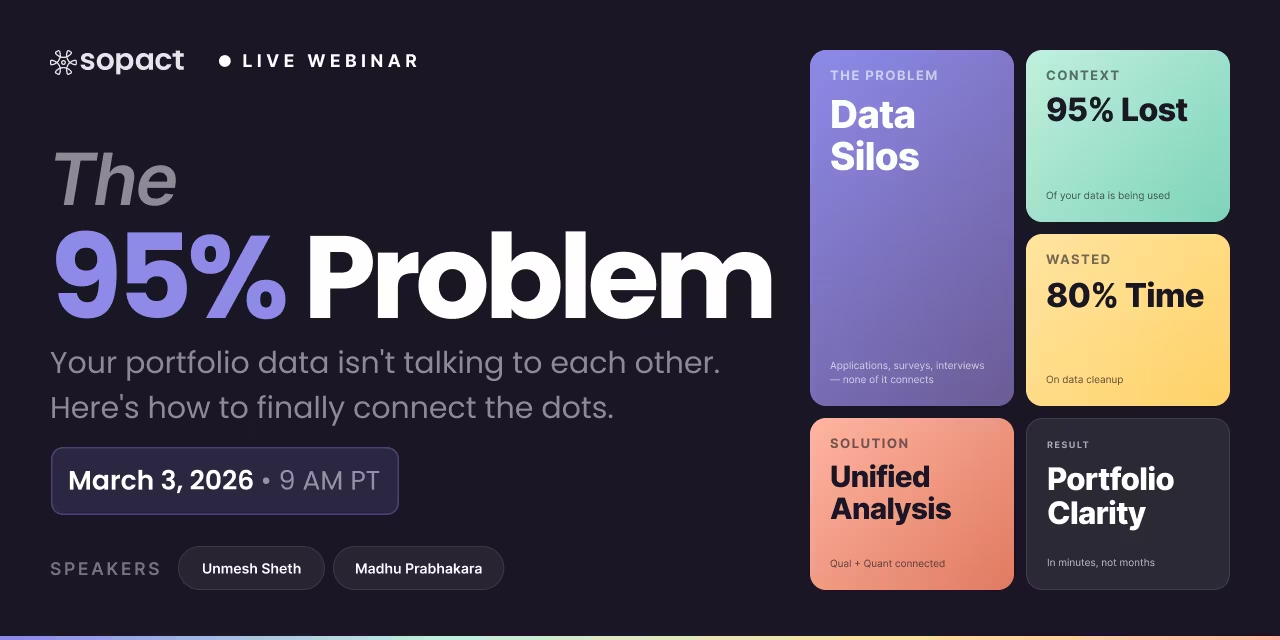
New webinar on 3rd March 2026 | 9:00 am PT
In this webinar, discover how Sopact Sense revolutionizes data collection and analysis.
Training assessment measures skills, knowledge, and competencies across the full learning lifecycle. Learn modern assessment methods that replace months of manual analysis with real-time insights.
Training assessment is the systematic process of measuring participant skills, knowledge, and competencies before, during, and after a training program to determine whether learning objectives have been met and real behavioral change has occurred. Unlike training evaluation, which judges overall program effectiveness, training assessment focuses on the individual learner — what they knew at baseline, what they gained, and whether they can apply it.
Most organizations get assessment wrong — not because they lack data, but because their assessment process is structurally broken. They collect pre-training surveys on one platform, track attendance in another, gather post-training feedback in a spreadsheet, and then spend weeks manually reconciling everything before they can answer the basic question: did this training work?
The result is what practitioners call the assessment gap — a widening distance between the data organizations collect and the insights they actually use. According to the Association for Talent Development, only 56% of organizations conduct a formal training needs assessment, yet 68% of those who do report that it meaningfully improved training outcomes. The problem is not whether assessment works. The problem is that traditional assessment workflows are too fragmented and too slow to deliver insight when it matters.
This article covers every dimension of training assessment — from needs assessment before training begins, through real-time knowledge checks during delivery, to competency verification after completion — and explains how modern AI-native approaches are replacing the months-long manual analysis cycle with continuous intelligence.
Training assessment encompasses every measurement touchpoint across the learning lifecycle. It is broader than training evaluation, which focuses specifically on program-level effectiveness, and more structured than informal feedback collection. A comprehensive training assessment system answers five questions:
What skills gaps exist before training begins? This is the training needs assessment — the diagnostic phase that determines what training should cover, who should receive it, and what success looks like. Without a rigorous needs assessment, organizations invest in training that addresses perceived problems rather than actual competency gaps.
What is each participant's baseline? Individual skills assessment establishes where each learner starts. This baseline is essential for measuring growth, but most organizations skip it because baseline data collection is tedious, manual, and disconnected from post-training measurement systems.
Did participants acquire the intended knowledge? Knowledge assessment during and immediately after training measures whether the content was absorbed. This maps directly to Level 2 (Learning) in the Kirkpatrick model, but most organizations limit it to a single post-course quiz — a measure of short-term recall, not real understanding.
Can participants apply what they learned? Competency assessment measures transfer — whether knowledge converts into changed behavior on the job. This is the hardest assessment to execute because it requires measurement over time, which means tracking the same individual across multiple touchpoints.
Is the training program itself well-designed? Program assessment evaluates the training's design, delivery, and structure. It is distinct from learner assessment — a program can be beautifully designed yet poorly taught, or vice versa.
Effective training assessment is not a single event — it is a continuous cycle with five distinct phases, each generating data that informs the next. Organizations that treat assessment as a one-time post-training survey miss four-fifths of the available intelligence.
Training needs assessment identifies the gap between current performance and required performance. It operates at three levels: organizational (what the company needs), task (what the role requires), and individual (what each person lacks).
The most common needs assessment methods include performance reviews, skills audits, manager interviews, and competency mapping. The challenge is synthesis — data comes from multiple sources in multiple formats, and reconciling it manually takes weeks. By the time the needs assessment is complete, organizational priorities may have shifted.
Modern approaches use AI to analyze performance data, interview transcripts, and survey responses simultaneously, surfacing the highest-priority skill gaps within hours rather than months. The key architectural requirement is a system that can process both quantitative metrics (performance scores, completion rates) and qualitative data (interview responses, open-ended feedback) in an integrated analysis.
Before training begins, each participant needs a baseline measurement against which growth will be evaluated. This typically combines self-assessment surveys, knowledge pre-tests, and skills demonstrations.
The structural problem with traditional baseline assessment is identity. When participants complete a pre-training survey in one system and a post-training assessment in another, there is no reliable way to link the two records. The individual's journey becomes invisible. Organizations end up reporting aggregate averages — "satisfaction increased from 3.2 to 4.1" — without being able to trace any individual's progression.
This is where persistent unique participant IDs transform assessment architecture. When every participant has a single identifier from their first interaction with the training system, their baseline data automatically connects to every subsequent measurement. No manual matching. No spreadsheet reconciliation. The individual learning journey builds itself. Learn more about how pre and post surveys create this measurement foundation.
Formative assessment happens during training delivery. It includes knowledge checks, practice exercises, peer assessments, and real-time comprehension monitoring. The purpose is not grading — it is course correction. Formative data tells instructors what participants are struggling with so they can adapt delivery in real time.
The formative assessment challenge for most organizations is scale. A facilitator running a workshop for 20 people can read the room. A training program running across 500 participants in 15 locations cannot. Formative data must be collected, analyzed, and surfaced fast enough for the trainer to act on it — which means automated analysis, not manual review.
Summative assessment occurs at the end of training. It measures what participants learned — knowledge gained, skills developed, competencies achieved. This is the assessment phase that most organizations actually execute, typically through post-course surveys and final knowledge tests.
But summative assessment alone is deeply insufficient. It tells you what participants know immediately after training, which is the peak of their knowledge curve. Without follow-up measurement, you cannot distinguish between genuine learning and short-term recall. Research consistently shows that participants lose 40-60% of newly learned information within weeks if they do not apply it.
The summative phase must connect forward to outcome measurement. This is where training assessment becomes training effectiveness measurement — but only if the data architecture allows individual-level tracking over time.
Transfer assessment — also called follow-up or delayed assessment — measures whether training actually changed behavior on the job. It happens weeks or months after training, and it is the assessment phase that most organizations skip entirely.
The reason is structural, not intentional. Transfer assessment requires reaching the same participants who completed training, measuring the same competencies that were assessed at baseline, and connecting the results to the original training data. With fragmented systems, this is a manual project that requires weeks of data reconciliation.
With integrated assessment architecture — where the participant's unique ID links their needs assessment, baseline, formative data, summative results, and transfer measurements in a single record — transfer assessment becomes a continuous process rather than a standalone project. Each touchpoint adds to the individual's learning trajectory automatically.
Organizations that successfully implement transfer assessment close the loop between training and outcome tracking, creating evidence for training ROI that goes beyond participant satisfaction scores.
Assessment methods fall into three categories: knowledge assessment (does the participant know it?), performance assessment (can the participant do it?), and attitude assessment (does the participant value it?). Each category requires different instruments and generates different types of data.
Knowledge assessments measure cognitive learning — facts, concepts, principles, and procedures that participants should have acquired.
Pre/Post Knowledge Tests are the most common knowledge assessment instrument. They establish what participants knew before training and what they know after. The gap is the measured learning gain. Effective pre/post tests use identical or parallel questions to ensure comparability. The challenge: writing questions that measure understanding rather than memorization.
Scenario-Based Questions present realistic workplace situations and ask participants to identify the correct response. They measure applied knowledge rather than rote recall and are particularly effective for training on procedures, safety, compliance, and decision-making.
Self-Assessment Scales ask participants to rate their own knowledge or confidence on specific competencies. While subjective, self-assessment data is valuable when tracked longitudinally — a participant who rates themselves 3/5 at baseline and 4/5 at post-training provides a meaningful signal, even if the absolute number is imprecise.
Performance assessments measure whether participants can execute skills, not just recognize them.
Skills Demonstrations require participants to perform a task while an assessor observes and rates their competency against a rubric. They are the gold standard for performance assessment but are expensive and time-consuming to scale.
Rubric-Based Evaluation applies standardized scoring criteria to participant work products — reports, presentations, code, designs, or other outputs. Rubrics enable consistent assessment across multiple evaluators and cohorts. AI-powered rubric analysis can now score open-ended work products against defined criteria, reducing assessment time from hours per participant to minutes.
360-Degree Feedback collects performance data from the participant's managers, peers, and direct reports. It measures behavioral change in context — whether the skills learned in training are visible in actual workplace interactions.
Attitude assessments measure motivation, confidence, satisfaction, and perceived value — the affective dimensions of learning that influence whether knowledge transfers to behavior.
Reaction Surveys (Kirkpatrick Level 1) capture participant satisfaction immediately after training. They are easy to administer but weakly predictive of actual learning or behavior change.
Confidence Scales measure participants' self-efficacy — their belief in their ability to perform specific tasks. Research shows that confidence scores correlate more strongly with behavior change than satisfaction scores.
Qualitative Feedback through open-ended questions captures context that structured instruments miss. When a participant writes "I finally understand why we do it this way" or "I still don't see how this applies to my role," that qualitative signal tells you more than any Likert scale. The challenge is analyzing qualitative feedback at scale — a problem that AI-native analysis tools are uniquely positioned to solve.
For decades, training assessment has operated on an annual cycle. An organization identifies training needs (usually through an annual performance review process), designs and delivers training, administers a post-training survey, and compiles results into a report months later. By the time decision-makers see the assessment data, the information is stale and the opportunity to improve has passed.
This approach has three structural flaws:
Assessment data lives in silos. The needs assessment happens in one system, training delivery in another, post-training surveys in a third, and performance data in a fourth. No single system holds the complete assessment picture, so every analysis requires manual data reconciliation.
Assessment is disconnected from individuals. Without persistent participant IDs, there is no reliable way to trace one person's journey from needs assessment through training to transfer. Organizations report cohort averages, which mask the variance that matters most — who benefited, who did not, and why.
Analysis is manual and retrospective. Even when data is collected, analyzing it takes weeks or months. Open-ended feedback sits unread because manually coding qualitative responses across hundreds of participants is prohibitively time-consuming. The richest assessment data — participant narratives about what worked and what did not — is the data organizations are least equipped to use.
AI-native assessment architecture inverts every structural flaw of the old paradigm.
Integrated data architecture. A single platform manages the full assessment lifecycle — from needs assessment surveys through baseline measurement, formative checks, summative tests, and transfer follow-ups. Data flows between phases automatically because it was designed to be connected, not retrofitted after the fact.
Persistent participant identity. Every participant has a unique ID from their first interaction. Their baseline data, training responses, assessment scores, and follow-up measurements are automatically linked. Individual learning trajectories are visible without manual matching.
Real-time AI analysis. Qualitative responses are analyzed as they arrive — themes extracted, sentiment scored, rubrics applied — not months later by hand. When 200 participants complete a post-training assessment, the analysis is available in minutes, not weeks. This means formative data can actually inform formative decisions, and summative data can drive program improvements before the next cohort begins.
Continuous feedback loops. Assessment is not a point-in-time event but a continuous process. Each assessment touchpoint generates intelligence that feeds into the next cycle. Needs assessment data informs training design. Formative data adjusts delivery. Summative data triggers transfer follow-ups. Transfer data feeds back into needs assessment for the next training cycle.
Building an effective training assessment framework requires four structural decisions: what to measure, when to measure it, how to connect measurements to individuals, and how to analyze the results.
Start with the competencies your training program targets. For each competency, define assessment across three dimensions:
This three-dimensional approach prevents the common trap of assessing only knowledge and then wondering why behavior does not change. If participants know the content but lack confidence in applying it, no amount of knowledge testing will surface the gap.
For each competency dimension, decide which assessment phases apply:
Assessment PhaseKnowledgeSkillDispositionNeeds assessmentPrior knowledge surveyCurrent skills auditMotivation baselineBaselinePre-testSkills demonstrationConfidence scaleFormativeKnowledge checksPractice exercisesEngagement pulseSummativePost-testFinal skills demonstrationReaction + confidenceTransferRetention test (delayed)On-job observationBehavioral follow-up
Not every cell requires a separate instrument. A well-designed survey can capture knowledge, skill self-assessment, and confidence in a single interaction — if the questions are structured intentionally.
The most critical technical decision is how participant data flows between assessment phases. If needs assessment data lives in a spreadsheet, baseline data in a survey tool, and summative data in an LMS, the individual's journey is invisible.
The architectural solution is a persistent unique identifier assigned to each participant at their first interaction. This ID travels with them through every assessment touchpoint, automatically linking their data across phases without manual reconciliation.
Manual assessment analysis is where most training assessment processes break down. The assessment data is collected — but it sits in export files for weeks before anyone analyzes it.
AI-native analysis changes this fundamentally. Quantitative data (test scores, scale ratings, completion metrics) is analyzed instantly with statistical comparison across cohorts, time periods, and demographics. Qualitative data (open-ended responses, interview transcripts, free-text feedback) is analyzed through theme extraction, sentiment scoring, and rubric-based coding — processes that previously required trained evaluators and weeks of manual work.
The result is that assessment intelligence is available as fast as data enters the system. A training program that completes on Friday can have complete assessment analysis — including qualitative themes, competency scores, and individual learning trajectories — available Monday morning.
The terms "training assessment" and "training evaluation" are often used interchangeably, but they serve different purposes in the learning measurement ecosystem.
Training assessment focuses on the learner. It measures what individuals know, can do, and feel — before, during, and after training. Assessment data is granular and individual-level. Its primary audience is trainers, instructional designers, and the learners themselves.
Training evaluation focuses on the program. It judges whether a training initiative achieved its objectives, delivered value, and should continue, be modified, or be discontinued. Evaluation data is aggregated and program-level. Its primary audience is program managers, executives, and funders.
The relationship is architectural: assessment generates the data that evaluation consumes. You cannot evaluate a training program's effectiveness without individual assessment data — and assessment data without evaluation context is measurement without meaning.
The Kirkpatrick model bridges both: Level 1 (Reaction) and Level 2 (Learning) are primarily assessment — measuring individual responses and knowledge. Level 3 (Behavior) and Level 4 (Results) are primarily evaluation — measuring program-level impact. Understanding which level you are working at determines whether you need assessment instruments (surveys, tests, rubrics) or evaluation instruments (ROI analysis, organizational metrics, longitudinal comparisons).
For a complete overview of evaluation methods, see our guide to training evaluation: 7 methods to measure training.
Post-training smile sheets are the most common assessment instrument — and the least predictive of actual learning. Research consistently shows weak correlation between participant satisfaction and knowledge transfer. A training that participants enjoyed may have taught them nothing; a challenging training they found frustrating may have produced deep learning.
Fix: Always pair reaction data with at least one objective knowledge or skills measure. Confidence scales ("How confident are you in applying X?") outperform satisfaction scales ("How satisfied were you with the training?") as predictors of transfer.
Without baseline measurement, post-training assessment scores are uninterpretable. A participant who scores 80% on a post-test may have known 75% before training (minimal gain) or 30% (substantial gain). Cohort averages without baselines are even more misleading.
Fix: Build pre and post surveys into every training assessment design. If time constraints prevent full pre-testing, use retrospective pre/post assessment — a validated technique where participants rate their pre-training and post-training knowledge at the same time.
Open-ended questions generate the richest assessment data — participants explain why they learned (or did not), what they will apply (or will not), and how the training connected to their actual work. But most organizations either do not collect qualitative data or collect it and never analyze it because manual coding is too time-consuming.
Fix: Use AI-powered qualitative analysis to process open-ended responses at scale. Theme extraction, sentiment analysis, and rubric-based coding can analyze hundreds of qualitative responses in minutes — work that would take a trained evaluator weeks.
When needs assessment data lives in one tool, training delivery in another, and post-training surveys in a third, the complete assessment picture requires manual data matching. Most organizations never complete this matching, which means their assessment data is structurally incomplete.
Fix: Use an integrated assessment platform with persistent participant IDs that automatically link data across all assessment phases. The technical architecture matters more than the survey questions — brilliantly designed surveys in disconnected systems produce less insight than simple surveys in an integrated system.
A single post-training assessment captures the peak of the learning curve. Without follow-up measurement at 30, 60, or 90 days, you cannot distinguish genuine learning from temporary recall. Yet most organizations assess once and move on.
Fix: Build outcome tracking into the assessment design from the start. When persistent IDs connect initial assessment data to follow-up measurements automatically, delayed assessment becomes a scheduled event, not a special project.
The fundamental constraint of traditional training assessment is not data collection — most organizations collect more assessment data than they can analyze. The constraint is analysis speed. When it takes weeks to process open-ended feedback, code qualitative themes, reconcile data across systems, and produce an assessment report, the insight arrives too late to inform action.
AI-native assessment architecture removes this constraint entirely. Here is what changes:
Needs assessment goes from quarterly to continuous. Instead of conducting annual needs assessments that are outdated by the time they are complete, AI continuously analyzes performance data, feedback patterns, and skill metrics to surface emerging training needs in real time.
Baseline and summative assessment connect automatically. Persistent participant IDs eliminate the manual matching that makes longitudinal assessment impractical. Each participant's pre-training data automatically pairs with their post-training and follow-up data.
Qualitative analysis scales. The richest assessment data — open-ended responses, interview transcripts, reflective journals — is no longer the data organizations cannot use. AI extracts themes, scores against rubrics, and surfaces patterns across hundreds of participants in minutes.
Assessment feeds program improvement in real time. When formative assessment data is analyzed as it arrives, instructors can adapt during delivery. When summative data is available within hours of training completion, program designers can improve the next cohort's experience immediately — not months later.
Individual learning trajectories become visible. Instead of cohort averages that hide individual variation, assessment intelligence shows each participant's journey from baseline through training to transfer. Program managers can identify who is thriving, who is struggling, and what differentiates them.
This is the shift from assessment as a compliance exercise to assessment as a continuous intelligence system — and it is the architectural approach that modern training organizations are adopting to replace the months-long manual analysis cycle with real-time insight.
When evaluating training assessment tools, focus on five architectural capabilities rather than feature lists:
Data integration. Can the tool manage the full assessment lifecycle — from needs assessment through transfer measurement — in a single system? Or does it handle only one phase, requiring manual reconciliation with other tools?
Participant tracking. Does the tool assign persistent unique IDs that follow participants across assessment phases? Or does each survey create a new anonymous dataset?
Qualitative analysis. Can the tool analyze open-ended responses at scale — extracting themes, scoring rubrics, and surfacing patterns? Or does it only handle structured data (multiple choice, Likert scales)?
Analysis speed. How fast does assessment data become actionable insight? Minutes (AI-native analysis)? Days (automated reporting)? Weeks (manual export and analysis)?
Continuous learning. Does the system support iterative assessment design — adapting questions, instruments, and timing based on what previous assessment cycles revealed? Or is each assessment cycle independent?
Tools that excel at data collection but require separate platforms for analysis, and tools that handle quantitative data well but cannot process qualitative responses, will perpetuate the same assessment gaps that manual processes create.
Assessment tools and frameworks matter — but they fail without organizational culture that values continuous measurement. Three cultural shifts accelerate assessment adoption:
Shift 1: Assessment as learning, not judgment. When participants view assessment as a way to track their own growth rather than a test they might fail, participation rates increase and response quality improves. Frame every assessment instrument as a growth tool, not an evaluation mechanism.
Shift 2: Speed over perfection. Organizations that wait for the perfect assessment framework never start. Begin with simple, connected assessments — a three-question pre-survey and a three-question post-survey linked by participant ID — and iterate. More data collected in an integrated system beats less data collected in a perfect but disconnected one.
Shift 3: Insight drives action. Assessment data that sits in reports nobody reads erodes trust in the assessment process. Every assessment cycle should produce at least one visible change — a modified training module, a new support resource, a different delivery approach. When participants see that their assessment responses led to tangible improvements, future assessment participation increases.
Training assessment is the systematic process of measuring participant knowledge, skills, and competencies before, during, and after training to determine whether learning objectives have been met. It encompasses needs assessment (identifying skill gaps), baseline measurement (establishing starting points), formative assessment (monitoring progress during training), summative assessment (measuring outcomes after training), and transfer assessment (verifying that learning translates to workplace behavior change).
Training assessment focuses on the individual learner — measuring what they know, can do, and feel at specific points in the learning journey. Training evaluation focuses on the program — judging whether the training initiative achieved its objectives and delivered organizational value. Assessment generates data at the individual level; evaluation synthesizes that data into program-level conclusions. Both are essential, but they serve different audiences and answer different questions.
Training assessment methods fall into three categories. Knowledge assessments (pre/post tests, scenario questions, self-assessment scales) measure whether participants acquired the intended information. Performance assessments (skills demonstrations, rubric-based evaluations, 360-degree feedback) measure whether participants can apply what they learned. Attitude assessments (reaction surveys, confidence scales, qualitative feedback) measure motivation, self-efficacy, and perceived value.
Training needs assessment identifies the gap between current performance and required performance across three levels: organizational (what the company needs to achieve its goals), task (what specific roles require), and individual (what each person lacks). Common methods include performance data analysis, manager interviews, skills audits, competency mapping, and employee surveys. The output is a prioritized list of skill gaps that training should address.
Effective training assessment is not a single event but a continuous cycle. Needs assessment should be ongoing rather than annual, baseline assessment happens before each training program, formative assessment occurs throughout delivery, summative assessment happens at training completion, and transfer assessment follows up at 30, 60, and 90 days post-training. AI-native assessment platforms enable this continuous approach by automating data collection and analysis across all phases.
The five most common training assessment mistakes are: assessing only participant satisfaction (which weakly predicts actual learning), skipping baseline measurement (which makes post-training data uninterpretable), ignoring qualitative data (which contains the richest diagnostic information), fragmenting data across disconnected systems (which prevents longitudinal tracking), and treating assessment as a one-time event (which captures only peak knowledge, not lasting behavior change).
AI transforms training assessment by automating the analysis bottleneck. Traditional assessment processes collect data adequately but analyze it too slowly — open-ended responses sit unread for weeks, cross-system data reconciliation takes months, and qualitative coding requires trained evaluators. AI-native assessment platforms analyze quantitative and qualitative data as it arrives, extract themes from open-ended responses at scale, apply scoring rubrics automatically, and surface patterns across cohorts in minutes rather than months.
A comprehensive training assessment framework includes five elements: clearly defined competencies to assess (knowledge, skills, and dispositions), assessment instruments mapped to the training lifecycle (needs, baseline, formative, summative, transfer), persistent participant identification for longitudinal tracking, integrated data architecture that connects all assessment phases, and analysis workflows that convert raw data into actionable insight quickly enough to inform program improvement.