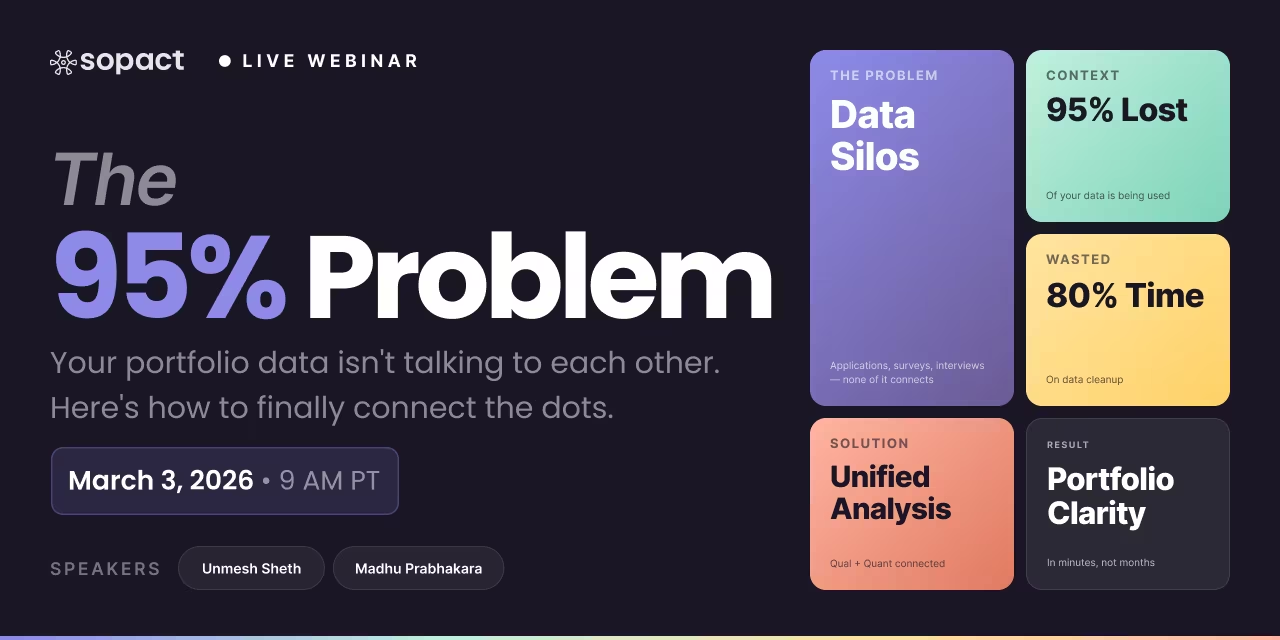
New webinar on 3rd March 2026 | 9:00 am PT
In this webinar, discover how Sopact Sense revolutionizes data collection and analysis.
Sopact Grant Intelligence helps CSR teams assess grant applications before review, evaluate what grantees delivered against their promises, and measure live program KPIs — without the 80% data cleanup tax that comes with disconnected tools
Reading every proposal before your first reviewer opens a file. Comparing what grantees promised to what they delivered. Measuring portfolio outcomes in real time. These are three different problems — and most CSR tools only solve one of them.
When a CSR program director describes what keeps them up at night, the answer almost never starts with "we need a better dashboard." It starts with: "We have 300 grant applications and twelve weeks to make funding decisions. We have no consistent way to evaluate them." Or: "We funded twenty organizations last year and I can't tell you with confidence whether any of them delivered what they proposed." Or: "The board asked me what our community impact was this quarter and it took three weeks to produce a number I wasn't fully confident in."
These are three distinct problems — assessment before funding, evaluation after funding, and measurement across the portfolio — and they require three different capabilities working together. This page covers all three, and specifically how Sopact's Grant Intelligence platform connects them in a way that community foundations, corporate CSR teams, and mid-market grantmakers have not been able to achieve with traditional tools.
This page does not cover GRI or CSRD compliance reporting. Sopact is not designed for enterprise ESG disclosure. If that is your primary need, tools like Workiva or Watershed serve that buyer. If you run grants, scholarships, community investments, or CSR award programs and need to assess, evaluate, and measure them — read on.
The failure point for most CSR program teams is not a lack of data. It is a lack of architecture. Applications arrive in a portal. Supporting documents land in email. Reviewer scores accumulate in a spreadsheet. Progress reports come in through a different system entirely. And at the end of the year, the program officer who needs to compare what grantee A originally proposed against what they actually reported has to manually reconstruct that context from four different places.
This fragmentation has a cost that most teams underestimate until they try to calculate it. Across CSR program teams relying on disconnected tools, the research is consistent: 80% of evaluation time is spent on data reconciliation and cleanup before any actual analysis begins. A team spending ten hours per week on grant evaluation is getting two hours of actual insight from that investment. The other eight hours are overhead — matching IDs, exporting data, reformatting reports, chasing missing documents.
The fix is not a better analysis tool layered on top of fragmented data. The fix is connecting assessment, evaluation, and measurement at the source, so the same record that captures an application is the record that tracks grantee outcomes two years later. That is what Sopact Grant Intelligence is built to do.
CSR grant assessment is the process of evaluating whether a proposed project or organization deserves funding — before the check is written. Most CSR teams do this manually: program officers read proposals, assign scores, discuss impressions in committee, and make funding decisions based on a synthesis of those impressions. At 30 applications that process works. At 300 it breaks down, and the decisions made at application 280 are statistically less reliable than the decisions made at application 30, because reviewer fatigue is real and the rubric interpretation drifts.
Sopact Grant Intelligence changes the mechanics of CSR assessment in three ways that traditional grant management platforms — Foundant, Submittable, Fluxx — structurally cannot.
AI reads the documents, not just the form fields. When an applicant uploads a 30-page proposal PDF alongside a budget spreadsheet and three letters of support, Sopact does not simply store those files. It reads them — extracting the narrative about community need, evaluating the methodology against your rubric criteria, checking the budget for feasibility, analyzing the letters for specificity and endorsement strength. Reviewers receive a structured pre-read summary rather than a document stack. The assessment happens before the human review begins, not during it.
Rubric scoring is adaptive, not locked. Every other platform in the CSR grant management category locks the rubric at launch. If the committee realizes mid-cycle that "community engagement" needs to be weighted more heavily, or that a new criterion should distinguish finalists from the broader pool, the options are to live with the misalignment or ask reviewers to re-score manually. In Sopact Grant Intelligence, criteria are updated in natural language — the program team describes the change, the AI applies the updated rubric to every application in the pool instantly. No manual re-scoring, no lost time.
Incomplete applications get corrected before review begins. When an applicant submits without the required financial documentation or leaves a critical narrative section blank, Sopact identifies the gap and sends the applicant a secure unique link to correct the specific missing item — not a form rejection, not an email back-and-forth. In a foundation pilot, 98% of incomplete proposals were resolved before first review, saving the program team hundreds of hours of back-and-forth. The committee evaluates complete applications, not partially filled submissions with staff notes in the margins.
The result of these three capabilities together is a CSR assessment process where a triage cycle that previously consumed six weeks of reviewer time completes in days — and the decisions at the end of that cycle are more consistent, more defensible, and better documented than any manual process could produce. See how CSR Grant Assessment works in Sopact →
CSR program evaluation is the hardest part of grantmaking that most tools treat as an afterthought. Traditional grant management platforms are designed around the application decision. Once a grant is made, the rich context from that application — the narrative about community needs, the detailed theory of change, the specific outcomes promised — effectively disappears. Post-award reporting happens in a separate module, often with no connection to the original proposal. The program officer reviewing a Year 1 progress report starts from scratch, with no mechanism to compare what the grantee is reporting against what they originally proposed.
This is not a workflow problem. It is an architectural one. And it is why CSR evaluation in most foundations looks like a program officer manually pulling up the original proposal in one window and the grantee report in another, trying to cross-reference them against notes from a site visit that happened eight months ago.
Sopact Grant Intelligence carries the full context of the original application forward through the grantee relationship. The persistent grantee ID that was assigned at the point of application submission is the same ID attached to the Year 1 progress report, the Year 2 outcome survey, and the exit interview. When a grantee submits a progress narrative, Sopact reads it against the original proposal automatically — surfacing where outcomes are tracking as promised, where there are gaps between stated intentions and reported activities, and where the narrative contains signals that the program officer should follow up on.
Cross-grantee evaluation becomes possible at scale. A CSR team managing twenty grantees simultaneously cannot read 200 pages of narrative reports and synthesize portfolio-level patterns in any reasonable timeframe. Sopact does this automatically. When AI reads across all twenty grantee progress reports using consistent evaluation criteria, it surfaces patterns that no human process would find in a manual review — which grantees are reporting similar barriers, which program models are generating stronger outcome evidence, which communities are underrepresented in the impact being reported. A foundation using Sopact reduced its cross-portfolio evaluation cycle from four months of manual synthesis to a continuously updated dashboard. The finding that shaped their next funding cycle — that grantees serving rural populations consistently reported technology access as a primary barrier — came not from a program officer reading every report, but from AI reading them all.
Qualitative evidence stops being a burden and becomes an asset. The open-ended feedback that grantees provide in progress reports, outcome surveys, and exit interviews contains the most important signals about whether a program is working. It is also the data that most CSR teams cannot analyze at scale because doing so requires reading hundreds of documents individually. Sopact processes qualitative narratives the moment they arrive, extracting themes, scoring against rubric criteria with sentence-level citations, and flagging where the evidence is strong versus where claims are unsubstantiated. The qualitative analysis that previously required a consultant and a month of work is available within hours of data collection. See how CSR Program Evaluation works in Sopact →
CSR measurement — tracking the KPIs, dashboards, and performance metrics that a board or funder needs — is where most teams feel the cleanup tax most acutely. Not because the data doesn't exist, but because it lives in too many places and requires manual assembly before it can be presented.
The board meeting scenario that CSR program directors describe most often: it is the evening before a quarterly review, the program officer is exporting survey data from one tool, cross-referencing it with application outcomes from another, and trying to reconcile both against the grantee progress reports that came in by email. The board report that results from this process is three weeks old by the time it is presented, and the data confidence behind the headline numbers is lower than anyone in the room acknowledges.
Sopact Grant Intelligence eliminates the reconciliation sprint because the data that feeds the dashboard is the same data that runs the program. Application scores, grantee progress, participant outcome surveys, and cross-portfolio analysis all update the same system in real time. There is no export step, no matching step, no cleanup step between data collection and measurement.
What CSR program KPIs look like in a connected system:
Portfolio reach and intake quality are available from the moment applications close — not after a staff member exports and cleans the data. How many applications were received, from which geographies and demographics, with what distribution of AI-assessed quality scores. This tells the board whether the program is attracting the right applicants before a single funding decision is made.
Funding deployment and grantee progress update continuously as grantees submit milestone reports, progress narratives, and outcome data. A program director can show the board not just how much was awarded and to whom, but how each grantee is tracking against their original proposal commitments — with the AI-generated evidence to support or complicate that picture.
Equity analysis across the grantee portfolio — whether funding is reaching the communities it was designed for, whether outcomes differ across demographic segments, whether the selection process introduced systematic bias — generates automatically from the same data that runs everything else. This is the analysis that funders increasingly require and that currently takes weeks to build from disconnected spreadsheets. In Sopact it is a dashboard view updated in real time.
A board-ready CSR impact report that used to require six weeks of assembly generates in four minutes from live data. The same report that was archaeology last quarter is current intelligence this quarter. See how CSR Measurement works in Sopact →
The reason most CSR program teams treat assessment, evaluation, and measurement as separate problems requiring separate tools is that every platform they have tried was built around one of the three. Grant management platforms like Foundant GLM, Submittable, and Fluxx are built around application workflow — they are genuinely good at intake, reviewer management, and award administration. They were not built to carry application context into grantee tracking, and they were not built to connect grantee tracking into portfolio measurement.
Sopact Grant Intelligence is not a replacement for what those platforms do well. For organizations using Foundant or Fluxx for core grant administration, Sopact functions as the intelligence layer that sits alongside them — handling the application analysis, grantee evaluation, and measurement that traditional GMS platforms structurally cannot provide.
For CSR teams starting fresh or moving off spreadsheets, Grant Intelligence handles the full lifecycle: AI-powered application assessment, persistent grantee tracking that carries proposal context forward, cross-portfolio qualitative analysis, and live dashboards that generate board reports from data already in the system. The same platform that scored your grant applications is the platform that tells you, two years later, whether the funded work delivered on its promises.
This is the distinction that matters for a CSR program director: not which tool has the most features, but which architecture connects the intelligence you need across the full lifecycle of a grant program — from the day applications open to the day outcomes are reported to the board.
The right tool depends on which part of the CSR program lifecycle you need to support. For enterprise ESG compliance — carbon accounting, supply chain risk, GRI and CSRD disclosure — platforms like Workiva and Watershed serve that buyer. For managing the full lifecycle of a grant program — assessing applications before review, evaluating grantee delivery against original proposals, and measuring portfolio outcomes across a funding cycle — Sopact Grant Intelligence provides AI-powered assessment, persistent grantee tracking, and live portfolio dashboards that traditional grant management platforms cannot match.
Most enterprise ESG platforms aggregate activity data — dollars granted, hours volunteered, programs funded — and present it in sustainability disclosures. Sopact takes a different approach: it connects the activity to grantee-level outcomes measured over time. If your board asks whether your community investment grant program actually improved outcomes for the organizations and communities you funded, Grant Intelligence answers that with longitudinal data connecting the original application narrative to grantee progress reports and final outcomes — not just financial activity.
CSR assessment is the process of evaluating whether a proposed grant, community investment, or program deserves funding — reading proposals against your rubric criteria, scoring applications, and making defensible selection decisions. ESG assessment typically refers to evaluating an organization's environmental, social, and governance practices for compliance or investment screening. For CSR program teams, the assessment challenge is reading hundreds of proposals consistently and fairly — which is what Sopact's AI does before your first reviewer opens a file.
Effective CSR program evaluation requires carrying the context of the original funding decision forward into grantee tracking. The question is not just "what did grantees report?" but "how does what they reported compare to what they originally proposed?" Sopact Grant Intelligence connects every grantee's progress report to their original application using a persistent unique ID, enabling direct comparison across all stages of the grant lifecycle. Cross-grantee AI analysis identifies portfolio-level patterns — which program models are producing stronger outcome evidence, which communities are underrepresented, which grantees need follow-up — continuously rather than through a quarterly manual synthesis.
The most important CSR KPIs for grant program teams span three levels: intake and assessment quality (application volume, eligibility rate, AI quality score distribution by geography and demographic), funding deployment and grantee progress (awards made, milestone completion rates, grantee narrative health scores), and portfolio outcome metrics (participant-level outcomes at 30/90/180 days, equity distribution across funded communities, cross-grantee theme patterns from qualitative analysis). The KPIs that matter most to boards are typically the outcome and equity metrics — both of which require longitudinal data connected across the grant lifecycle, not single-cycle snapshots.
Most teams are running live data within two weeks of onboarding. Setup involves configuring application forms and rubrics, mapping existing KPI definitions, and connecting any current data sources. No data engineering work is required from your team — Sopact's configuration layer handles the data architecture. Implementations alongside existing GMS platforms like Foundant or Fluxx typically take one to two days for standard deployments, with the first AI analysis available as soon as applications begin arriving.
Related: Grant Intelligence · CSR program management software · CSR program impact reporting · Grant management software