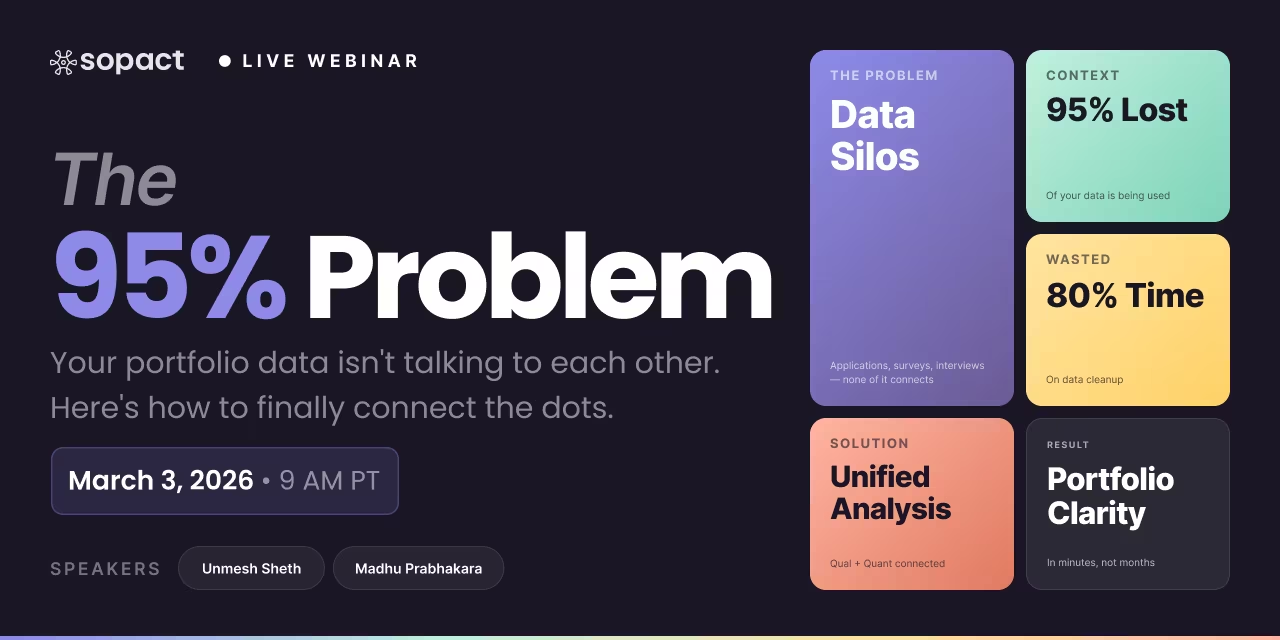
New webinar on 3rd March 2026 | 9:00 am PT
In this webinar, discover how Sopact Sense revolutionizes data collection and analysis.
Social impact assessment guide with frameworks (IRIS+, SDGs, B4SI), real-world examples, AI-powered tools, and a step-by-step methodology. Learn how to conduct rigorous SIA in 2026.
Social impact assessment is a systematic process for evaluating how programs, projects, policies, or investments affect people and communities. It measures outcomes across livelihoods, health, education, employment, equity, social cohesion, and cultural preservation — combining quantitative metrics with qualitative evidence to determine what changed, for whom, how much, and why.
SIA is one of 12 types within the broader discipline of impact assessment, but it is the most widely practiced form among nonprofits, foundations, government agencies, and development organizations. While environmental impact assessment focuses on ecosystems and ESG assessment integrates governance metrics, social impact assessment centers on the human experience: did this intervention improve lives, and can we prove it with evidence stakeholders trust?
The challenge practitioners face in 2026 is not whether to measure social impact. Every funder requires it. Every board asks for it. The challenge is that traditional approaches — scattered surveys, months of data cleanup, consultants producing static reports that arrive after decisions are already made — waste 80% of assessment time on infrastructure rather than insight. AI-native platforms are transforming this reality by making every data point analysis-ready from the moment it enters the system.
You already know your program creates change. The problem is proving it — and proving it fast enough to matter.
Here is what the traditional social impact assessment workflow actually looks like. Your team launches intake surveys in Google Forms. Participant records live in a spreadsheet. Mid-program check-ins go through SurveyMonkey. Exit interviews get transcribed into Word documents. Qualitative stories sit in shared drives. Financial data stays in Excel. Every tool captures a fragment. No single system connects them.
The result: teams spend months reconciling fragments before any analysis begins. "John Smith" in the intake form might be "J. Smith" in the CRM and "Jonathan Smith" in the exit survey — and nobody discovers the mismatch until a consultant tries to match baseline data to outcomes. Qualitative evidence — the stakeholder voices, interview themes, and lived experiences that explain why outcomes happened — either gets manually coded one response at a time or gets summarized into a few anecdotes that miss the full picture.
Reports land on funders' desks six to twelve months after data collection. By then, the program has changed, the cohort has graduated, and the evidence describes a reality that no longer exists. Program managers who needed insights to adapt mid-cycle never received them. Funders who needed evidence before the next allocation deadline got a PDF too late.
This is not because practitioners lack skill or commitment. It is because the tools they rely on were designed for data collection, not for connected evidence pipelines. Survey platforms collect responses. Spreadsheets store numbers. QDA tools code transcripts. BI tools build dashboards. Each does its job. None talks to the others. The fragmentation is architectural — and no amount of cleaning, deduplicating, or reconciling fixes an architecture problem.
The traditional model for social impact assessment followed a well-worn path: hire a consultant, design surveys from scratch, collect data over months, wait for manual coding of qualitative responses, produce a static PDF report, file it for compliance, and repeat next year. This model optimized for accountability theater rather than learning. It assumed social impact was something you measured retrospectively rather than something you tracked continuously.
AI-native data architecture changes this fundamentally.
The old paradigm treated social impact assessment as a periodic event. Surveys launched at fixed intervals. Qualitative and quantitative data processed in entirely separate tools by separate teams. Analysis required specialized consultants. Results arrived as static documents months after collection — useful for annual reports but useless for program improvement.
The new paradigm treats social impact assessment as a continuous intelligence system. Every participant receives a unique ID at first contact that follows them through intake, mid-program check-ins, exit surveys, and follow-up assessments. Data arrives clean at the source because validation rules prevent quality problems before they start. Qualitative evidence — open-ended survey responses, interview transcripts, uploaded documents — processes alongside quantitative metrics in the same pipeline, analyzed by AI rather than manually coded by overwhelmed analysts.
The critical difference is not adding AI features to legacy tools. It is building data architecture where every stakeholder response is AI-ready from the moment it enters — connected to a participant identity, validated in real time, and structured for mixed-method analysis without months of post-collection cleanup.
Sopact Sense embodies this architecture. Instead of forcing practitioners to stitch together survey tools, spreadsheet analysis, qualitative coding software, and dashboard builders, it provides a single pipeline where data quality is enforced at collection, qualitative and quantitative evidence analyzes side by side, and insights reach decision-makers while programs are still running.
Choosing a framework is the easy part. The hard part — the part that consumes months and consultant budgets — is turning that framework into working surveys, validated rubrics, connected dashboards, and funder-ready reports. Most organizations do not fail because they chose the wrong framework. They fail because they cannot operationalize any framework fast enough.
Theory of Change maps the causal logic from inputs through activities, outputs, outcomes, and long-term impact. It is not a metric system but a methodological foundation. Every social impact assessment should start here — making assumptions explicit and testable before data collection begins. Without a Theory of Change, you collect data without knowing what it should prove.
IRIS+ provides a standardized catalog of impact metrics maintained by the Global Impact Investing Network. It enables comparability across portfolio companies and programs, making it the default framework for impact investors. For social impact assessment specifically, IRIS+ offers pre-defined indicators for education, health, employment, financial inclusion, and livelihoods that translate directly into survey questions.
The 17 SDGs and 169 targets offer a universal alignment tool. Funders increasingly require SDG mapping to demonstrate global relevance. For practitioners, the challenge is that SDGs are broad — "Quality Education" (SDG 4) does not tell you what to measure. Pairing SDGs with operational indicators from IRIS+ or custom rubrics bridges the gap between global alignment and local evidence.
B4SI standardizes measurement of corporate community investment — inputs, outputs, and impacts — enabling benchmarking across organizations and sectors. CSR teams conducting social impact assessment of their community programs use B4SI to report in a format their peers and boards recognize.
The 2X framework defines specific gender-lens thresholds across leadership, employment, entrepreneurship, and financial inclusion. Social impact assessments with a gender equity dimension use 2X to score investments and programs against measurable inclusion benchmarks.
The real practitioner pain is not selecting a framework. It is executing one. Traditional operationalization looks like this: hire a consultant ($50,000–$150,000), spend three months mapping indicators to survey questions, build custom data collection tools, train field teams, collect data over six months, hire analysts to clean and code it, produce a report twelve months later.
Sopact is framework-agnostic by design. Select your framework (or combine multiple), map indicators into templates in days, collect qualitative and quantitative data with unique participant IDs, and generate reports aligned to IRIS+, SDGs, B4SI, 2X, or custom rubrics from the same underlying dataset. What traditionally consumed a year of consultant-driven setup now operates in weeks.
Whether you are a nonprofit program manager, foundation officer, or government evaluator, rigorous social impact assessment follows a consistent methodology. These five steps work across program types, scales, and frameworks — from a youth employment initiative serving 200 participants to a multi-country development program reaching 50,000 stakeholders.
Clarify what decisions the assessment will inform before designing any data collection. Who are the primary stakeholders? What outcomes will you measure? What time period applies? What population is included? A one-page scope document prevents the most common SIA failure: collecting massive amounts of data that nobody uses because it does not answer the questions decision-makers actually ask.
Establish your Theory of Change at this stage. Map expected causal pathways from inputs to long-term impact. Make assumptions explicit — "If we provide mentoring, participants will gain confidence, leading to job interviews, leading to employment." Each assumption becomes a testable hypothesis that data collection is designed to validate.
This is where most social impact assessments succeed or fail — and most fail here.
Assign unique participant IDs from day one. Every participant receives a persistent identifier at first contact that links their intake survey, mid-program check-ins, exit assessment, and any follow-up. Without this, you cannot track individual journeys or distinguish participants across data sources.
Design surveys with validation rules. Prevent empty submissions, standardize date formats, enforce consistency at the point of entry rather than cleaning it up after the fact. Every response should be AI-ready the moment it enters.
Capture qualitative and quantitative data together. Do not relegate open-ended questions to a separate tool. Include narrative prompts — "Describe how this program affected your daily life" — alongside scaled metrics in the same instrument. This ensures qualitative evidence feeds the same pipeline as quantitative data.
Build always-on collection, not one-time snapshots. Instead of annual surveys, deploy persistent links that participants access when they have something to share. Quarterly structured check-ins supplement continuous feedback.
Deploy surveys at intake (baseline), mid-program, exit, and post-program follow-up. Each touchpoint links to the participant's unique ID, building a longitudinal record without manual matching.
For qualitative depth, collect interview transcripts, program documents, stakeholder narratives, and uploaded evidence alongside survey data. The most credible social impact assessments combine multiple evidence types — triangulating survey metrics with interview themes to validate findings.
Self-correction mechanisms let participants review and update their own responses through unique links — ensuring data accuracy without requiring staff to chase corrections manually.
Quantitative analysis examines outcome changes against baselines: pre-post comparisons disaggregated by demographics, geography, and program components. Cohort tracking reveals whether early participants show different outcomes than later ones. Statistical analysis identifies which program elements correlate most strongly with positive outcomes.
Qualitative analysis identifies themes across open-ended responses, interview transcripts, and documents. AI-powered analysis processes hundreds of narrative responses in minutes — extracting themes, scoring sentiment, detecting patterns, and correlating qualitative findings with quantitative outcomes. What once required weeks of manual coding by trained researchers now happens automatically.
Mixed-method integration is where social impact assessment delivers its deepest value. Quantitative data shows what changed and for whom. Qualitative data explains why and how. The combination produces evidence that is both credible (numbers) and compelling (stories) — exactly what funders, boards, and policymakers need.
Translate findings into audience-specific formats. Funders receive framework-aligned outcome reports. Program managers get operational dashboards with real-time indicators. Boards see strategic KPIs with trend lines. Communities receive accessible summaries that demonstrate accountability.
The most critical step is acting on findings. Social impact assessment evidence should directly inform program modifications while programs are still running — not arrive as a retrospective document after the cohort has graduated. Build feedback loops that connect insights to decisions in real time.
Social impact assessment is not a theoretical exercise. Here are the contexts where it creates the most value — and where traditional approaches break down.
A training program serving 500 participants across three cities needs to track skills acquisition (pre-post assessment), job placement rates, retention at 30/90/180 days, employer satisfaction, and participant confidence. Without unique IDs linking intake to outcome, the program cannot determine which training components drive employment. Without qualitative analysis, it cannot explain why participants in one city outperform those in another.
A health initiative measuring maternal health outcomes across rural clinics needs to combine clinical data, survey responses, and community health worker narratives. Traditional approaches fragment clinical metrics (spreadsheet), patient surveys (Google Forms), and qualitative reports (Word documents) across three systems. Longitudinal tracking requires connecting a participant's first prenatal visit to delivery outcomes — impossible without persistent IDs.
A foundation managing 30 grantees needs portfolio-level social impact assessment: aggregating outcomes across diverse programs while respecting programmatic differences. Each grantee reports differently — different formats, different metrics, different timelines. The foundation spends months reconciling data before producing a portfolio report. AI-native platforms standardize collection with shared templates while allowing program-specific customization, then aggregate outcomes automatically.
An accelerator supporting 200 entrepreneurs needs to measure business viability, social impact, job creation, and ecosystem effects over three years. Participants complete quarterly assessments linked to their unique ID. AI analyzes open-ended responses about challenges, pivots, and breakthroughs alongside revenue and employment metrics — producing evidence that the accelerator actually contributed to outcomes, not just graduated cohorts.
The social impact assessment tools market has consolidated significantly. Between 2020 and 2026, purpose-built platforms like Social Suite pivoted to ESG compliance. Proof and Impact Mapper ceased operations. Many practitioners default to stitching together survey tools, spreadsheets, and consultant services — a workflow that guarantees the fragmentation problem.
Unique participant identification that connects every data touchpoint through a persistent ID. This is the single most important capability. Without it, longitudinal tracking requires manual matching — and manual matching fails at scale.
Mixed-method collection that captures quantitative surveys and qualitative narratives in the same instrument. Separate tools for separate data types guarantee the fragmentation that consumes 80% of assessment time.
AI-powered qualitative analysis that processes open-ended responses, interview transcripts, and uploaded documents automatically — extracting themes, scoring rubrics, and detecting sentiment without manual coding.
Framework-agnostic reporting with pre-built templates for IRIS+, SDGs, B4SI, 2X, and custom rubrics. The ability to generate multiple framework-aligned views from one dataset eliminates the re-mapping that traditionally takes months.
Real-time dashboards that update as new data arrives and generate audience-specific reports from plain-language prompts.
Self-service configuration that enables program teams to set up assessments without IT support or consultant engagement.
Sopact's Intelligent Suite processes mixed-method social impact data at every level. Intelligent Cell analyzes individual responses — scoring rubrics, extracting themes from essays, processing uploaded documents. Intelligent Row summarizes each participant's complete journey in plain language. Intelligent Column compares patterns across cohorts — revealing which demographics show strongest outcomes and why. Intelligent Grid synthesizes portfolio-level findings for funders and boards.
The architecture advantage is structural: unique participant IDs from day one, validation at the point of collection, qualitative and quantitative data in the same pipeline, and framework alignment built into templates rather than bolted on after the fact.
The difference between traditional and modern social impact assessment is not cosmetic — it is architectural. Traditional approaches stitch together disconnected tools and rely on human effort to bridge the gaps. Modern approaches build a unified data architecture where connections happen automatically.
Traditional social impact assessment starts with easy-to-launch survey tools that create the fragmentation problem. No unique IDs means no longitudinal tracking. Qualitative data gets exported to a separate system — if it gets analyzed at all. Dashboards require expensive BI setup. Reports arrive months after decisions have been made.
Modern social impact assessment starts with clean data architecture. Unique IDs from day one. Validation at collection. Qualitative and quantitative evidence in one pipeline. Dashboards update in real time. Reports generate in minutes from the same dataset that feeds dashboards. Frameworks align at setup, not after months of consultant mapping.
The result: organizations that once spent twelve months producing a single social impact assessment report now generate continuous insights, adapt programs mid-cycle, and demonstrate outcomes to funders while funding decisions are still being made.
Social impact assessment (SIA) is a systematic process for evaluating how programs, projects, policies, or investments affect people and communities. It measures outcomes across livelihoods, health, education, employment, equity, and social cohesion — combining quantitative metrics with qualitative evidence to determine what changed, for whom, how much, and why. SIA is the most widely practiced form of impact assessment among nonprofits, foundations, and development organizations.
Impact assessment is the umbrella term covering 12 types including social, environmental, economic, ESG, risk, and gender-lens assessments. Social impact assessment is one specific type focused on human and community effects. While environmental impact assessment measures ecological outcomes and ESG assessment integrates governance metrics, SIA centers on lived experience: did the intervention improve people's lives, and what evidence proves it?
The most common frameworks include Theory of Change (causal pathway mapping), IRIS+ (standardized impact metrics from GIIN), SDGs (global alignment targets), B4SI (corporate social investment standards), and 2X Global Criteria (gender-lens thresholds). Most organizations need to report across multiple frameworks, making framework-agnostic platforms that collect data once and generate multiple aligned reports essential.
Traditional social impact assessments take six to twelve months from data collection to final report, with 80% of that time consumed by data cleanup and manual qualitative coding. AI-native platforms compress this to weeks: automated validation at collection, AI-powered mixed-method analysis in minutes, and real-time dashboard generation. Continuous assessment models deliver insights while programs are still running.
The most effective SIA tools provide unique participant identification, mixed-method data collection (quantitative and qualitative together), AI-powered qualitative analysis, framework-agnostic reporting, real-time dashboards, and self-service configuration. Sopact Sense delivers all six capabilities in one platform. Traditional alternatives require stitching together Google Forms (collection), NVivo (qualitative coding), Excel (analysis), and Tableau (dashboards) — creating the fragmentation that dominates assessment timelines.
A strong SIA report includes an executive summary, methodology description, quantitative outcomes disaggregated by demographics, qualitative insights from stakeholder narratives and thematic analysis, framework alignment (IRIS+, SDGs, etc.), and actionable recommendations. Modern reports are delivered as live dashboards where stakeholders explore findings interactively rather than reading static PDFs.
Yes. AI-native platforms with subscription pricing, pre-built templates, and automated analysis make rigorous SIA accessible at any scale. Organizations serving 50 to 500 participants run assessment processes that previously required enterprise budgets. Self-service setup means program teams configure assessments in days, not months — and iterate without consultants.
Qualitative evidence reveals the mechanisms behind quantitative outcomes. Numbers show what changed; narratives explain why and how. AI-powered analysis processes hundreds of open-ended responses in minutes — extracting themes, detecting sentiment, scoring rubrics, and correlating qualitative patterns with quantitative outcomes. This integration produces evidence that is both statistically credible and narratively compelling.
Social impact assessment specifically measures outcomes and effects on people and communities. Monitoring tracks whether activities are being implemented as planned (process monitoring). Evaluation is a broader term that includes process evaluation, formative evaluation, and summative evaluation. SIA is one component within M&E, focused on the "so what" question — did the intervention create meaningful change?
Data quality starts at collection, not cleanup. Assign unique participant IDs from day one. Use validation rules that prevent empty submissions and standardize formats. Deploy self-correction links that let participants update their own responses. Capture qualitative and quantitative data in the same instrument. Organizations that enforce quality at the source eliminate the 80% cleanup problem that dominates traditional SIA timelines.