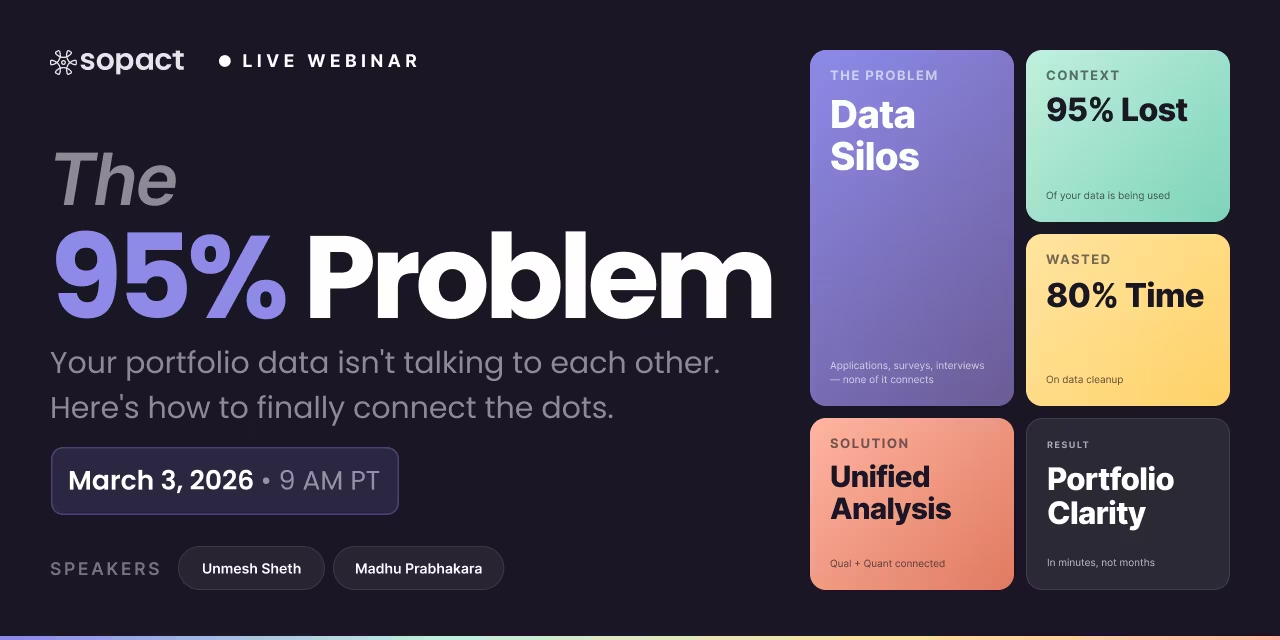
New webinar on 3rd March 2026 | 9:00 am PT
In this webinar, discover how Sopact Sense revolutionizes data collection and analysis.
Impact assessment tools, frameworks, and AI-powered software for 2026. Learn how to automate social, environmental, and ESG assessments with clean data architecture and real-time reporting
Author: Unmesh Sheth
Impact assessment is a systematic process for evaluating the effects of programs, projects, policies, or investments on people, communities, and the environment. It combines quantitative metrics with qualitative evidence to determine what changed, for whom, how much, and why — then translates those findings into decisions about what to do next.
Organizations across sectors use impact assessment to satisfy funder requirements, meet regulatory standards, improve program design, and demonstrate accountability to stakeholders. The practice spans 12 distinct types — from social and environmental impact assessment to ESG, risk, gender-lens, and training assessments — each with its own frameworks, methodologies, and reporting requirements.
The challenge in 2026 is not whether organizations should conduct impact assessments. The challenge is that traditional approaches take too long, cost too much, and produce insights that arrive after decisions have already been made. AI-native platforms are transforming this reality by automating data collection, processing qualitative and quantitative evidence simultaneously, and delivering real-time dashboards instead of static annual reports.
Every organization faces pressure to prove outcomes — from funders, regulators, investors, and the communities they serve. Impact assessments were supposed to provide answers. Instead, they became a compliance burden.
Here is what actually happens. Your team collects survey data in Google Forms. Participant records live in a CRM. Interview transcripts sit in shared drives. Financial data stays in Excel. Each tool captures a fragment, but no single system connects a participant's baseline survey to their mid-program check-in to their exit interview.
The result: teams spend up to 80% of their assessment time on data cleanup — reconciling duplicate names across spreadsheets, fixing inconsistencies that break pivot tables, manually coding open-ended responses one at a time, and chasing missing data points. Qualitative evidence — the stories, interviews, and stakeholder voices that explain why outcomes happened — rarely makes it into dashboards at all.
Reports arrive six to twelve months after data collection. By then, programs have changed, funding cycles have moved on, and the evidence reflects a reality that no longer exists. Only 29% of nonprofits report measuring impact effectively, despite 76% calling it a priority.
This is not a talent problem or a motivation problem. It is an infrastructure problem. The tools most organizations rely on were never designed to connect fragmented data streams into a unified evidence pipeline.
The traditional impact assessment model followed a predictable pattern: design a framework, build surveys from scratch, collect data over months, hire consultants to clean and analyze it, produce a static report, and repeat the cycle next year. This model optimized for compliance, not learning. It assumed that impact evidence was something you assembled retrospectively rather than generated continuously.
AI-native architecture changes this equation fundamentally.
The old paradigm treated assessment as an event. Data collection happened at fixed intervals. Analysis required specialized consultants. Qualitative evidence was processed separately from quantitative data — if it was processed at all. Reports were static PDFs delivered months after collection, useful for accountability but too late for program improvement.
The new paradigm treats assessment as a continuous system. Data arrives clean at the source because unique participant IDs eliminate duplication and validation rules prevent quality problems before they start. Qualitative and quantitative evidence processes in the same pipeline — essays, interviews, and survey scores analyzed simultaneously by AI rather than in separate tools by separate teams. Dashboards update in real time as new data flows in. Reports generate from plain-language prompts in minutes, not months.
The critical architectural difference is not adding AI features to legacy workflows. It is building data architecture where every response is AI-ready from the moment it enters the system — connected to a participant identity, validated at entry, and structured for mixed-method analysis without post-collection cleanup.
Sopact Sense embodies this new architecture. Instead of forcing organizations to stitch together survey tools, spreadsheet analysis, qualitative coding software, and BI dashboards, it provides a single pipeline where data is clean at the source, qualitative and quantitative evidence are analyzed side by side, and insights reach decision-makers while decisions can still be changed.
Impact assessment is not a single methodology — it is a family of approaches, each tailored to different sectors, stakeholders, and evidence requirements. Whether you are evaluating a workforce training program, tracking ESG compliance across a portfolio, or preparing for a sustainability audit, the type of assessment determines which frameworks apply, what data you need, and how results should be reported.
Below are the 12 most common types. Each one traditionally requires months of manual setup, data wrangling, and consultant support. With AI-native platforms, each can now be configured in days and run continuously.
Social impact assessment evaluates how programs, projects, or investments affect people and communities — measuring outcomes across livelihoods, health, education, equity, and social cohesion. It is the most widely practiced form of impact assessment among nonprofits, foundations, and development agencies. Read the complete Social Impact Assessment guide →
Environmental impact assessment measures how projects affect ecosystems, biodiversity, and climate. Mandatory in many jurisdictions for energy, mining, and construction projects, EIAs involve processing 200–300 page compliance reports, modeling environmental risks, and tracking mitigation commitments over time. Learn more about Environmental Impact Assessment →
Business impact analysis assesses how disruptions affect organizational resilience — identifying critical processes, dependencies, and risks to ensure continuity during crises. Traditional approaches rely on Excel risk registers updated annually; AI-native platforms monitor risks continuously with real-time alerting.
Change impact assessment tracks how organizational shifts — digital transformation, mergers, restructuring — affect employee readiness, adoption, and sentiment. Instead of annual engagement surveys that produce static snapshots, continuous feedback models detect resistance and adaptation gaps in real time.
Economic impact assessment quantifies how programs, investments, or policies affect local, regional, or national economies. It measures job creation, income generation, tax revenues, and multiplier effects. Traditional approaches require costly econometric modeling; AI platforms automate extraction of economic outcomes from grantee reports and stakeholder surveys.
Risk impact assessment identifies vulnerabilities across compliance, cyber, supply chain, and climate domains. Static annual audits miss emerging threats. Real-time risk monitoring combines survey data, incident reports, and external signals to flag evolving exposure patterns before they escalate.
Gender-lens assessment measures how programs and investments support women's leadership, employment, entrepreneurship, and financial inclusion. The 2X Global Criteria framework defines specific thresholds that qualify investments for gender-lens designation. Assessment requires both demographic data and qualitative narratives about agency, confidence, and equity.
Corporate social responsibility assessment evaluates how companies invest in communities, innovate for social impact, and manage responsible procurement. The B4SI framework standardizes measurement of inputs, outputs, and impacts across corporate investments, enabling benchmarking across organizations and sectors. Explore CSR Measurement →
Sustainability assessment integrates environmental, social, and governance performance into one holistic analysis. As ESG reporting requirements expand globally, organizations must map outcomes to GRI, SASB, SDG, and TCFD indicators — a process that traditionally requires months of consultant-driven data consolidation. Read more about Sustainability Assessment →
Training assessment evaluates whether programs — bootcamps, vocational training, corporate upskilling — actually build skills, confidence, and long-term employability. Without longitudinal tracking through unique participant IDs, organizations cannot determine whether graduation outcomes translate into sustained career advancement. Explore Training Assessment →
Organizational assessment measures internal health: governance, leadership, culture, diversity, equity, and operational maturity. Funders and accelerators use it to benchmark grantees. Traditional approaches deliver static maturity matrices; continuous assessment tracks whether capacity-building investments actually improve organizational performance over time. Read about Organizational Assessment →
Integrated ESG assessment brings together environmental, social, and governance data into one cohesive framework for investors, regulators, and multinational enterprises. The challenge is consolidating siloed E, S, and G data streams — typically managed by different departments — into a single reporting structure aligned with GRI, SASB, SDGs, and investor rubrics simultaneously.
Most organizations do not fail because they lack a framework. They fail because they cannot operationalize one. Frameworks define what to measure, but they do not tell you how to capture clean data, merge surveys with interview transcripts, or make dashboards update in real time. That gap is where most teams burn months and consultant budgets.
IRIS+ (GIIN) provides a standardized catalog of impact metrics widely used by investors and funds. It enables comparability across portfolio companies but requires manual mapping into surveys and databases.
Sustainable Development Goals (SDGs) offer a universal alignment tool for mapping outcomes to global development targets. Often too broad unless paired with specific operational indicators.
GRI (Global Reporting Initiative) provides detailed sustainability reporting standards strong for ESG disclosures. Complex to implement across multiple entities and reporting periods.
SASB (Sustainability Accounting Standards Board) connects industry-specific ESG outcomes to financial materiality. Highly valued by investors but demands extensive, structured data collection.
2X Global Criteria define gender-lens investment thresholds across leadership, employment, products, and financial inclusion. Require both quantitative tracking and qualitative assessment of inclusion and agency.
B4SI (Business for Societal Impact) standardize corporate responsibility measurement across inputs, outputs, and impacts. Used globally by corporations benchmarking community investment.
Theory of Change maps expected causal pathways from inputs to long-term outcomes. Not a metric system but a methodological foundation on which other frameworks sit.
The real pain for practitioners is not choosing a framework. It is turning one into working surveys, validated rubrics, connected dashboards, and funder-ready reports. This process traditionally takes months of consultant mapping — and the result is often a one-off setup that cannot adapt when a new funder asks for different framework alignment.
Sopact is framework-agnostic by design. Instead of rebuilding workflows for every framework, organizations select the framework (or combine multiple), map indicators into templates in minutes, collect qualitative and quantitative data with unique participant IDs, and generate reports aligned to IRIS+, SDGs, B4SI, 2X Criteria, or custom rubrics from the same underlying dataset. What GIIN spent years building as a static taxonomy, organizations can operationalize in days with the right data architecture.
The tools your organization uses determine how fast and how well raw data becomes decisions. For most teams, impact assessment still means juggling four or five disconnected systems — and spending months reconciling the fragments.
Survey tools like Google Forms, SurveyMonkey, and Typeform make it easy to launch data collection but create the fragmentation problem that dominates every subsequent step. No unique participant IDs. No longitudinal tracking. No connection between a participant's survey response and their interview transcript or program attendance record. Qualitative data — open-ended responses, essays, interview notes — is either ignored or exported into a separate system for manual coding.
Analysis tools like Excel, SPSS, and Airtable are where analysts spend weeks cleaning and merging files before they can begin actual analysis. Pivot tables break when naming conventions vary between spreadsheets. Statistical analysis requires clean, structured data that rarely exists after collection.
Dashboard tools like Tableau, Power BI, and Google Data Studio produce polished visualizations — but only after someone has built manual data pipelines, written SQL queries, and maintained ETL connections. These tools visualize data; they do not collect, validate, or analyze it.
Consultants bring framework expertise and reporting discipline, but they deliver static PDFs that are expensive to produce and impossible to update. A single engagement costs $50,000 to $200,000 and produces evidence that is outdated by publication.
AI-native impact assessment platforms unify the entire pipeline: collection, validation, analysis, and reporting in one system. The architectural advantages are structural, not cosmetic.
Clean data at the source. Every participant receives a unique ID at first contact. Surveys validate responses in real time — flagging outliers, preventing empty submissions, and standardizing formatting. Data quality problems are prevented rather than cleaned up after the fact.
Mixed-method analysis in one pipeline. Qualitative data — open-ended survey responses, interview transcripts, uploaded documents — processes alongside quantitative metrics. AI extracts themes, scores rubrics, and detects sentiment from unstructured text without manual coding.
Real-time dashboards with no BI setup. Dashboards update automatically as new responses arrive. No ETL pipelines, no SQL queries, no consultant-dependent maintenance.
Framework-agnostic reporting. Collect data once; generate reports aligned to IRIS+, SDGs, B4SI, 2X Criteria, GRI, or custom funder rubrics from the same dataset. Changing frameworks does not require changing data collection.
Continuous feedback loops. Always-on survey links, correction mechanisms, and longitudinal tracking transform assessment from an annual event into a continuous intelligence system.
An impact assessment report is only as strong as the data architecture behind it. The best-written report still fails if the data is fragmented, the analysis is delayed, and the insights arrive after decisions have moved on.
Executive summary distills findings, recommendations, and decision points into two pages or less. This is the section most stakeholders actually read — it must stand alone as a decision-making document.
Scope and methodology describes what was assessed, the population and time period covered, data collection methods, sample sizes, and analytical approaches. Transparency here builds trust in the findings.
Quantitative outcomes present metrics tied to frameworks — employment rates, income changes, health indicators, environmental measures — disaggregated by demographics, geography, and program components. Numbers without context lack credibility, so every metric should connect to the theory of change that explains why change was expected.
Qualitative insights reveal the mechanisms behind the numbers. Thematic analysis of interviews, open-ended responses, and stakeholder narratives explains why outcomes occurred, identifies unexpected consequences, and surfaces the lived experience that quantitative data alone cannot capture.
Framework alignment maps findings to whichever frameworks funders or regulators require — IRIS+, SDGs, GRI, B4SI, or custom rubrics. The ability to generate multiple framework-aligned views from one dataset eliminates the manual re-mapping that traditionally consumes weeks.
Risks, gaps, and recommendations identify data limitations, emerging risks, and actionable changes. The best reports do not just describe what happened — they tell decision-makers what to do about it.
Traditional impact assessment reports are static documents that become outdated the moment they are published. Modern platforms replace this with dashboards that update continuously — stakeholders explore findings interactively, track progress in real time, and generate audience-specific views from one underlying dataset.
A funder sees IRIS+-aligned outcome metrics. A program manager sees disaggregated participant outcomes with qualitative context. A board member sees strategic KPIs with trend lines. All views draw from the same clean data, eliminating version control nightmares and month-long report production cycles.
Whether you are a nonprofit practitioner, foundation officer, impact investor, or government evaluator, rigorous impact assessment follows a consistent methodology. These five steps apply across all 12 assessment types.
Clarify what decisions the assessment will inform, who the primary stakeholders are, and what boundaries apply (time period, geography, population, outcomes). A one-page scope document prevents scope creep and ensures the assessment produces usable evidence rather than generic data.
Map the causal logic from inputs through activities, outputs, outcomes, and long-term impact. This makes your assumptions explicit and testable. Then select the frameworks your stakeholders require — IRIS+, SDGs, B4SI, or custom rubrics — and map indicators before data collection begins, not after.
This is where most assessments succeed or fail. Assign every participant a unique identifier from day one. Design surveys with validation rules that prevent empty submissions and standardize formatting. Structure collection so qualitative and quantitative data feeds the same pipeline. The goal is AI-ready data at the source — not months of cleanup after the fact.
Quantitative analysis examines outcome changes against baselines, disaggregated by demographics and program components. Qualitative analysis identifies themes across transcripts, open-ended responses, and documents. The most powerful assessments integrate both: quantitative data shows what changed and for whom, qualitative data explains why and how.
Translate findings into audience-specific formats — funder reports, program learning briefs, community summaries, board presentations. Then act. Assessment findings should directly inform program modifications, resource allocation, and stakeholder communication. Evidence that does not connect to decisions is wasted effort. Build feedback loops that ensure insights reach decision-makers while they can still change outcomes.
The impact assessment software market has consolidated significantly. Between 2020 and 2026, purpose-built platforms like Social Suite pivoted to ESG. Proof and Impact Mapper ceased operations. The QDA market — led by NVivo (30% share) and ATLAS.ti (25% share) — continues growing but remains disconnected from data collection and reporting workflows.
What practitioners actually need is not another point solution. They need integrated platforms that eliminate the fragmentation between collection, analysis, and reporting.
Unique participant identification that connects every touchpoint — surveys, interviews, documents, observations — through a persistent ID. Without this, longitudinal tracking requires manual matching.
Mixed-method data collection that handles quantitative surveys, qualitative text, uploaded documents, and multimedia within a single system. Separate tools for separate data types guarantee fragmentation.
AI-powered qualitative analysis that processes open-ended responses, transcripts, and documents automatically — extracting themes, scoring rubrics, and detecting sentiment without manual coding.
Framework alignment with pre-built templates for IRIS+, SDGs, GRI, SASB, B4SI, 2X Criteria, and custom rubrics. Changing frameworks should not require redesigning data collection.
Real-time dashboards and automated reporting that update as new data arrives and generate audience-specific reports from plain-language prompts.
Self-service configuration that enables program teams to set up assessments, modify questions, and adjust logic without IT support or consultant engagement.
Sopact Sense delivers all six capabilities in one AI-native platform. Its Intelligent Suite — Intelligent Cell (individual response analysis), Intelligent Row (participant journey summaries), Intelligent Column (cohort pattern detection), and Intelligent Grid (portfolio synthesis) — processes mixed-method data automatically at every level from individual data points to portfolio-wide insights.
Impact assessment is a systematic process for evaluating the effects of programs, projects, policies, or investments on people, communities, and the environment. It combines quantitative metrics with qualitative evidence to determine what changed, for whom, how much, and why — then translates findings into actionable decisions. Impact assessment spans 12 distinct types including social, environmental, economic, ESG, risk, gender-lens, training, organizational, and sustainability assessments.
Impact assessment focuses specifically on measuring the outcomes and effects of an intervention — what changed as a result. Evaluation is a broader term that can include process evaluation (was the program implemented as designed?), formative evaluation (how can the program be improved?), and summative evaluation (did the program achieve its goals?). Impact assessment is one component within a comprehensive evaluation framework, focused on the "so what?" question.
Impact assessment tools range from basic survey platforms like Google Forms and SurveyMonkey to enterprise systems like Qualtrics and purpose-built AI-native platforms like Sopact Sense. The most effective tools include unique participant identification for longitudinal tracking, mixed-method data collection that handles surveys and qualitative evidence together, AI-powered analysis of open-ended text, framework alignment capabilities, and real-time dashboards. The choice depends on your organization's size, data complexity, and whether you need integrated qualitative analysis.
Traditional impact assessments take six to twelve months from initial data collection through final reporting, with teams spending roughly 80% of that time on data cleanup, reconciliation, and manual qualitative coding. AI-native platforms compress this timeline to weeks by automating validation at collection, processing qualitative and quantitative data simultaneously, and generating reports automatically. The shift from annual to continuous assessment models means evidence reaches decision-makers while programs are still running.
A strong impact assessment report includes an executive summary with key findings and recommendations, methodology description with sample sizes and analytical approaches, quantitative outcomes disaggregated by demographics and program components, qualitative insights from stakeholder narratives and thematic analysis, framework alignment mapping to IRIS+, SDGs, or other required standards, and actionable recommendations that connect evidence to decisions. Modern reports are increasingly delivered as live dashboards rather than static documents.
Traditional impact assessment software focuses on one part of the workflow — data collection, analysis, or reporting — creating fragmentation between steps. AI-native platforms unify the entire pipeline: clean data collection with unique IDs, real-time validation, simultaneous qualitative and quantitative analysis, automated framework alignment, and live dashboards. The fundamental difference is data architecture: AI-native platforms make every response analysis-ready from the moment it enters the system, eliminating the 80% cleanup problem.
The most widely used frameworks include IRIS+ (standardized impact metrics for investors, maintained by GIIN), the SDGs (global alignment targets), GRI (sustainability reporting standards), SASB (industry-specific ESG materiality), 2X Global Criteria (gender-lens thresholds), B4SI (corporate social investment), and Theory of Change (causal pathway mapping). Most organizations need to report across multiple frameworks, making framework-agnostic platforms that collect data once and generate multiple aligned reports essential.
Yes. AI-native platforms with subscription pricing, pre-built templates, and automated analysis have made rigorous impact assessment accessible to organizations of all sizes. Small nonprofits serving 50 to 500 participants can now run assessment processes that previously required enterprise budgets and external consultants. Self-service configuration means program teams set up assessments in days, not months — and iterate without technical support.
Impact assessment is the umbrella term covering all 12 types — social, environmental, economic, risk, ESG, gender-lens, training, organizational, and others. Social impact assessment (SIA) is one specific type that focuses on human and community effects: livelihoods, health, education, equity, social cohesion, and cultural preservation. SIA is the most widely practiced form among nonprofits and foundations, while the broader impact assessment discipline spans corporate risk management, environmental compliance, and integrated ESG reporting.
The most effective approach replaces annual assessment cycles with continuous feedback models. Always-on stakeholder surveys feed live dashboards that surface insights in real time. Structured quarterly reviews examine trends and emerging patterns. Comprehensive annual reports synthesize findings for strategic planning and funder communication. Continuous models ensure evidence reaches decision-makers while decisions can still change outcomes — unlike annual cycles where insights arrive months too late.